When the Platform Becomes the Product

OpenAI Dots, Instinct, and the feature-compression risk facing AI companies.

AI CAPITAL SIGNALS  /  SEPTEMBER 30, 2026

Core question

What remains of an AI company when a foundation platform can absorb its core capability into a broader agent, distribute it to an existing user base, and connect it to the same tools and workflows?


Solten Ventures
Independent research on capital, companies, and consequential decisions.

Audience: founders, investors, corporate strategy and product leaders

Research note. This is not investment advice.

Executive Summary

OpenAI launched Dots on September 29, 2026: an always-on agent in ChatGPT with its own cloud computer, persistent context, connected-app access, and the ability to keep making progress between conversations. One day earlier, Instinct announced a $1 billion Series C at a $10 billion valuation for a personal AI agent designed to handle everyday tasks across a user’s digital life. [1][2][3]

The timing creates a useful case study, but not yet a measurable outcome. Dots is too new to support claims about Instinct’s user retention, transaction volume, revenue, or valuation impact. The relevant signal is strategic: capabilities that can support a standalone AI company can also become native features of a foundation platform with existing distribution, identity, memory, integrations, compute, and billing.

The signal

AI startups can reach billion-dollar valuations faster than their core product categories can become platform features. The resulting risk is not simply competition. It is feature compression: the economic value of a standalone product can contract when the platform underneath it expands upward.


This report uses Instinct and Dots as an early case study in that risk. It then asks a practical question: how should founders, investors, and corporate buyers assess an AI company whose current value proposition could be reproduced by a general-purpose platform?

Five conclusions matter most:

  • Demand is not defensibility. A product can be useful, fast-growing, and still be structurally exposed to platform expansion.
  • AI capability is becoming a weaker moat. Durable value is shifting toward proprietary distribution, workflow ownership, transaction networks, unique data, trust, permissions, and real-world execution.
  • Horizontal AI products face the highest compression risk when their differentiation can be expressed as “general model + context + tools + interface.”
  • A platform launch should trigger a strategic re-underwriting, not panic. Some companies will be compressed; others will move deeper into a vertical, own transactions, become infrastructure, or use the platform as distribution.
  • Investors need a second diligence question beyond product-market fit: “If the foundation platform ships this capability natively, what remains valuable and difficult to reproduce?”

1. The Case: Instinct Meets Dots

Instinct describes itself as a personal assistant that connects to applications and devices including email, messaging, screen, audio, location and more. Users can text or call it; the agent is designed to use a phone and computer and handle tasks such as following up on neglected threads, arranging rides, booking services, and other everyday work. [3]

On September 28, Instinct announced a $1 billion Series C from Sequoia Capital, Benchmark and Coatue at a $10 billion valuation. Reuters described the company as developing a personal agent that can autonomously perform day-to-day tasks, while Instinct’s own release said the product remained in early access. [2][4]

On September 29, OpenAI introduced Dots. OpenAI’s help documentation describes a dot as an “always-on agent” in ChatGPT that can take ongoing responsibility, keep making progress between conversations, use its own cloud computer, work across connected apps, and remember context. Dots also inherits the permissions of supported plugins and connected services. [1][5]

Dimension Instinct OpenAI Dots Strategic implication
Core promise Personal agent for everyday life Always-on agent for ongoing responsibility Substantial overlap in the user-level job to be done
Execution surface Phone and computer Cloud computer; supported local access; browser and apps Platform can bundle execution infrastructure
Context Connected applications and devices Persistent context plus ChatGPT ecosystem Context advantage may shift toward incumbent relationship
Distribution Independent product; early access Native to ChatGPT plans and enterprise workspaces Distribution cost and discovery favor the platform
Integrations Must build and maintain connections Can use existing plugin/app permissions Platform ecosystem reduces integration friction
Business model pressure Must justify separate product relationship Can bundle agent value into existing subscription Standalone willingness-to-pay can be compressed


The correct interpretation is not that Dots has already damaged Instinct. It is that Instinct’s original category-level differentiation is now less scarce. “A personal AI agent that knows the user and acts across tools” is no longer, by itself, a sufficient explanation of why a separate company must exist.

2. What Feature Compression Means

Traditional platform risk is familiar: a large software vendor adds a feature that competes with a smaller product. AI changes the speed and scope of that process. A sufficiently capable general agent can absorb not one narrow feature but an entire class of workflows because the same underlying components—reasoning, memory, computer use, connected apps, and persistent execution—can be recombined across many use cases.

Feature compression

A decline in the independent economic value of a product category when a platform can provide a sufficiently good version of the same outcome as part of a broader system, existing subscription, or default user relationship.


This does not require the platform product to be superior. It only needs to be good enough that the marginal benefit of adopting a separate vendor no longer compensates for added cost, setup, permissions, trust, and workflow fragmentation.

The compression stack

Layer What the platform can bundle Why it matters
Intelligence Frontier models, reasoning, multimodal capability Core AI quality is increasingly rented rather than owned
Context Memory, files, email, chat, organizational data The incumbent can accumulate context before the startup is installed
Execution Browser, cloud computer, code, app actions The agent can act without a separate orchestration layer
Distribution Existing consumer or enterprise user base Near-zero incremental acquisition for a new feature
Identity & trust Existing account, permissions, admin controls Reduces friction of giving an agent sensitive access
Economics Bundled subscription and shared infrastructure Can pressure standalone pricing and gross margins


3. Which AI Companies Are Most Exposed?

The highest-risk companies are not necessarily weak companies. The issue is whether their value is located in a layer the platform can plausibly absorb. A strong product can still be strategically fragile.

Exposure level Typical characteristics What survives a platform copy?
High Horizontal assistant; thin orchestration; common integrations; model-dependent UX; little proprietary supply or data Brand, speed, some workflow polish—but often little structural moat
Medium Vertical product with domain workflows, accumulated context, specialized evaluations, compliance or embedded process ownership Domain know-how, switching costs, historical data, operational integration
Lower Controls transactions, proprietary supply, regulated infrastructure, network effects, critical systems of record, or hard-to-recreate data Value persists even if the platform matches the AI interface


A useful test is to remove the model from the pitch. If the company’s remaining assets are still valuable—customers, distribution, proprietary data, workflow rights, transaction rails, unique supply, regulated permissions, or network structure—the business may be durable. If almost all value disappears, the company is primarily renting intelligence and packaging it.

4. Four Market Scenarios

The likely outcome is not one universal collapse. Platform expansion will produce different outcomes depending on where a company’s defensibility actually sits.

Scenario A — Compression into a feature

The platform reaches “good enough” quality, bundles the capability, and removes the need for a separate subscription. Customer acquisition becomes harder, pricing weakens, and the startup either sells, narrows to a niche, or disappears. This is the base risk for horizontal wrappers and general-purpose assistants.

Scenario B — Vertical escape

The company moves from a broad assistant to a specific workflow where domain constraints matter: legal matter operations, healthcare administration, industrial maintenance, underwriting, procurement, or another environment with specialized data, approvals, audit requirements, and high switching costs. The platform becomes an input rather than a substitute.

Scenario C — Execution-layer ownership

The company uses the agent as the front end but builds defensibility in transactions, supply, merchant relationships, payments, booking, logistics, service networks, or other real-world execution. In this scenario, the AI interface can be replicated while the transaction graph cannot.

Scenario D — Platform complement

Instead of competing with the platform, the company becomes a specialized product distributed through it. OpenAI’s plugin architecture is relevant here: plugins can package instructions, connected apps, and reusable workflows inside ChatGPT and Codex. [6] This can create new distribution, but it also changes who owns the customer relationship and margin pool.

5. What Could Instinct Do?

Instinct has several credible strategic paths. The point is not to predict which one it will choose, but to show what a company in this position must prove after platform entry.

Path What Instinct would need to prove Main risk
Win the consumer relationship Meaningfully better personal understanding, execution reliability, trust and habit than general platforms Platform distribution overwhelms product-quality advantage
Own agentic commerce Build transaction volume, merchant relationships, payments, supply and service execution that platforms cannot instantly reproduce Low transaction frequency; dependence on third-party merchants
Build a personal execution network Coordinate people, services and agents through proprietary identity or trusted-person networks Network effects may be slow and expensive to establish
Specialize Focus on a high-value vertical or user segment Shrinks the original horizontal vision
Become infrastructure or a platform complement Provide capabilities or network access to larger ecosystems Loss of direct customer ownership and pricing power


The most important shift is conceptual: Instinct can no longer rely on “personal agent” as the moat. It must show that something accumulates as users transact through the product—data advantage, trust, network density, proprietary supply, lower execution cost, or another asset that does not reset when a competitor ships a similar interface.

6. What Founders Should Do When a Platform Enters Their Category

A platform launch is a reason to re-underwrite the company, not automatically to pivot. The response should be evidence-based and fast.

1. Re-map the value chain.

Separate the product into intelligence, interface, context, workflow, distribution, data, permissions, transactions and real-world execution. Mark which layers the platform now provides and which remain uniquely yours.

2. Test substitution, not feature parity.

Ask customers whether the platform product is good enough to replace you—not whether it has every feature. The dangerous competitor is often cheaper and more convenient, not objectively better.

3. Identify the accumulating asset.

Define what becomes more valuable every time the product is used. If the answer is only “more prompts” or “more model usage,” the moat is weak.

4. Move toward ownership.

Own a workflow, dataset, transaction, network, system of record, specialized evaluation, or permission boundary. The goal is to make the platform a supplier to you rather than a substitute for you.

5. Reprice the business model.

If a platform bundles a comparable capability, standalone seat pricing may not survive. Consider transaction economics, outcome pricing, embedded infrastructure, enterprise control layers, or other models tied to value the platform does not bundle.

6. Use the platform as distribution when rational.

If the category is being standardized, fighting the platform may destroy capital. A plugin, embedded workflow, API product, or specialized layer can sometimes produce a better risk-adjusted business than maintaining a full independent stack.

7. Shorten the strategic review cycle.

In fast-moving AI categories, annual strategy is too slow. Re-run platform-risk diligence after major model, agent, app, browser, memory, and enterprise distribution launches.

7. What Investors Should Change in AI Diligence

Product-market fit remains necessary, but it is no longer enough. A company can have strong adoption and still sit inside a platform’s expansion path. Investment underwriting should therefore include an explicit platform-compression analysis.

The second diligence question

If OpenAI, Anthropic, Google, Microsoft, Meta, or another foundation platform ships 80% of this capability inside an existing product, what remains scarce, valuable, and hard to reproduce?


Questions worth adding to diligence:

  • Which parts of the product are proprietary, and which are rented from model or infrastructure providers?
  • What would a platform need to reproduce to make the startup unnecessary—not identical?
  • Does the startup own the customer relationship, or is that relationship portable to the platform?
  • What improves structurally with scale: proprietary data, transaction economics, network density, supply, compliance position, or switching costs?
  • How much gross margin depends on model pricing that the platform itself controls?
  • Could the startup become a plugin or native workflow inside the platform? If so, does that strengthen distribution or eliminate differentiation?
  • What is the credible strategic response if a foundation provider enters the category within six months?
  • Is the valuation underwriting a company—or an early version of a future platform feature?

8. What Corporate Buyers Should Do

Enterprise buyers face the opposite problem: they may overcommit to a specialist vendor whose functionality is about to be bundled into a platform they already pay for. The answer is not to avoid startups; specialized vendors often move faster and understand the workflow better. The answer is to preserve optionality.

  • Prefer contracts with practical exit paths, data portability, and limited lock-in during fast platform transitions.
  • Separate vendor-specific workflow design from the underlying model whenever possible.
  • Measure operational outcomes, not novelty: completion rate, error rate, human review burden, time saved, and cost per successful task.
  • Ask whether the vendor’s value comes from domain process and data, or mainly from access to a general model.
  • Avoid duplicating sensitive permissions across many agents unless the incremental benefit is material.

9. What to Watch Over the Next 6–12 Months

The Instinct–Dots case is now testable. The market should watch observable evidence rather than narratives.

Indicator Why it matters
Instinct user growth and retention after broad Dots availability Tests whether users want a separate agent relationship
Transaction volume and revenue mix Shows whether value is moving from assistant UX into commerce/execution
Merchant, travel, service and payment partnerships Evidence of an execution moat beyond model capability
Dots reliability on multi-step real-world tasks Determines whether “good enough” substitution arrives quickly
OpenAI pricing and usage terms after the initial launch period Bundling economics can materially change standalone willingness-to-pay
Plugin ecosystem growth and third-party agent distribution Shows whether independent companies become complements rather than competitors
M&A and acqui-hire activity in horizontal agent startups Potential sign that standalone economics are compressing
Funding terms for general-purpose agent companies Tests whether capital markets begin pricing platform exposure more explicitly


10. A Practical Platform-Compression Test

A simple diagnostic can be used during product strategy, investment screening, or acquisition review. It is not a scorecard for predicting winners; it is a way to expose where the risk actually sits.

Question Low-risk answer High-risk answer
What is proprietary? Data, workflow rights, distribution, network, transactions Prompting, orchestration, interface
Who owns user context? Company accumulates unique operational history Platform already holds richer context
Who owns execution? Company controls transaction or real-world completion Company calls common APIs/tools
Can the platform bundle it? Requires specialized supply, regulation, or infrastructure Fits naturally into general agent
What accumulates with use? Network density, proprietary data, switching costs Mostly usage volume
What happens at 80% feature parity? Company remains necessary Separate product becomes hard to justify


Interpretation

If most answers fall in the right-hand column, the strategic question is not “How fast can we grow?” It is “What can we own before the platform reaches sufficient parity?”


Conclusion: The Company Must Be More Than the Capability

The Instinct–Dots sequence compresses a broader AI market dynamic into forty-eight hours. On September 28, investors valued a personal-agent company at $10 billion. On September 29, a foundation platform launched an always-on agent with persistent context, its own computer, connected apps, and native distribution. Neither event invalidates the other. Together, they show how quickly the boundary between “company” and “feature” can move. [1][2]

The durable lesson is not that foundation platforms will win every category. They will not. Specialized companies can still build enormous value. But the location of that value is changing. Intelligence and agent capability are becoming easier to access; durable advantage increasingly sits in what the model does not automatically provide: proprietary distribution, unique data, workflow ownership, trust, permissions, transactions, networks, infrastructure, and real-world execution.

For founders, the task is to identify and own that layer before the platform catches up. For investors, it is to underwrite the residual company after platform entry. For corporate buyers, it is to preserve optionality while measuring real operational outcomes.

The question is no longer only whether an AI product works. It is whether a durable company remains when the same capability becomes native to the platform.

Methodology and Limitations

This report is a strategic case analysis based on public information available through September 30, 2026. Because Dots launched on September 29, there is not yet sufficient post-launch evidence to attribute changes in Instinct usage, revenue, retention, transaction volume, or valuation to Dots. Statements about market structure and company responses are analytical scenarios, not claims about observed outcomes.

Sources

[1] OpenAI Help Center, “Getting started with your dot,” accessed September 30, 2026. https://help.openai.com/

[2] Reuters, “AI agent firm Instinct raises $1 billion in latest funding round,” September 28, 2026.

[3] Instinct, company website, accessed September 30, 2026. https://instinct.com/

[4] Instinct, “Instinct Raises $1 Billion in Series C Funding from Sequoia, Benchmark and Coatue at $10 Billion Valuation,” September 28, 2026 (company release distributed via Business Wire).

[5] OpenAI Help Center, “Manage dots in ChatGPT workspaces” and “Dots privacy, security, and safety FAQs,” accessed September 30, 2026.

[6] OpenAI Help Center, “Plugins in ChatGPT,” accessed September 30, 2026.

[7] The Verge, “OpenAI launches Dots, its Muse competitor,” September 29, 2026.

[8] TechCrunch, “Viral AI agent Instinct raises $1B Series C at a $10B valuation,” September 28, 2026.

About Solten Ventures

Solten Ventures is an independent research and analysis firm focused on capital, companies, and the decisions between them. Its work examines what is changing, what the evidence supports, what remains uncertain, and what deserves attention before consequential decisions are made.

soltenventures.com  |  hello@soltenventures.com

Stripe Is Buying the Control Plane for AI Economics

A fundamental analysis of OpenRouter, model-routing economics, and the strategic value of a neutral inference exchange.

SOLTEN & CO. RESEARCH  |  FLAGSHIP REPORT  |  24 AUGUST 2026  |  VERSION 1.1

Software AI  /  AI Infrastructure  /  Capital & Deals  /  Agentic Commerce

CENTRAL THESIS  Stripe is buying the point at which model choice becomes a financial decision: which supplier handles a request, what it costs, how usage is recorded, who is billed, and who is paid. OpenRouter could become a cross-provider economic-control plane. Stripe ownership could also compromise the neutrality on which that role depends.

Research snapshot

Field Detail
Publication date 24 August 2026
Evidence cut-off 21 August 2026
Research type Flagship report + strategic acquisition analysis
Primary audience Family offices, venture/growth investors, lean investment teams and strategy leaders
Estimated reading time 30 minutes
Evidence boundary Purchase price, consideration, and private-company financials are not company-disclosed

Executive summary

Stripe’s agreement to acquire OpenRouter is the highest-salience AI-economy transaction of August because it moves the contest for value capture away from model leadership and toward the infrastructure that allocates inference demand. OpenRouter stands between applications and a changing supply of models and inference providers. It can route each request by cost, quality, latency, reliability and policy; normalize usage records; bill the customer; and settle with the supplier. Stripe already controls much of the downstream revenue stack. The transaction links both sides of AI gross margin.

The companies disclosed neither price nor consideration. Reuters cited Bloomberg at more than $7 billion. Axios reported more than $8 billion in cash and stock, later describing the mix as mostly stock with some cash. Those reports imply a value more than five times the $1.3 billion valuation Axios associated with OpenRouter’s May Series B, but they are not definitive transaction terms. The economic rights in a financing round and a control acquisition also differ. The correct conclusion is not that OpenRouter’s standalone value increased sixfold in 83 days; it is that Stripe appears willing to pay for strategic option value unavailable to a minority investor.

OpenRouter has genuine operating scale but incomplete financial disclosure. The company said weekly usage rose from 5 trillion to 25 trillion tokens in six months and that it was on pace to process more than one quadrillion tokens in 2026. Current pricing pages list more than 500 models and 80 providers. Pay-as-you-go customers pay a 5.5% platform fee; enterprise discounts and substantial free BYOK allowances make the effective take rate unknowable. The company has disclosed routed inference spend—not recognized revenue—at selected earlier dates. Without model mix, average model price, BYOK share, customer concentration, provider rebates, payment costs and gross margin, token volume cannot support a revenue estimate.

The strategic logic rests on four possible assets. Demand aggregation can create purchasing power and make OpenRouter a distribution channel for new models. Cross-provider metadata can improve reliability and selection. Unified billing and settlement can turn a gateway into a two-sided exchange. Stripe can also join the cost ledger to the revenue ledger, allowing AI applications to optimize contribution margin rather than token price alone. None of these advantages is automatic. Cloud platforms bundle routers into existing procurement; Portkey and LiteLLM offer enterprise and self-hosted alternatives; and independent research finds that sophisticated routers do not always outperform simple baselines.

The central underwriting question is therefore not whether multi-model routing will exist. It will. The question is whether a Stripe-owned OpenRouter can remain sufficiently neutral, technically differentiated and commercially valuable to become the default cross-provider control plane. The thesis strengthens with evidence of enterprise spend retention, durable effective fees, broad provider access, audited cost-quality gains and transparent governance. It weakens if routing becomes a free cloud feature, providers bypass the exchange, or customers conclude that a payment company should not observe both their revenue and inference-cost metadata.

Key findings

  • This is a control-point acquisition. Routing determines request-level cost, quality, latency, reliability and policy eligibility; joining it to billing makes the decision economically consequential.
  • The reported price is strategic, not yet financially underwritable. No recognized revenue, gross margin, retention, concentration or definitive transaction consideration has been disclosed.
  • OpenRouter’s defensibility is a system, not an algorithm: demand aggregation, provider access, normalized telemetry, settlement, enterprise controls and low-friction switching.
  • Stripe reduced integration risk by working with OpenRouter before the acquisition. Their January partnership already connected invoicing, tax, fraud and usage records to changing inference costs.
  • The Series B investor coalition was unusually strategic: NVIDIA, ServiceNow, MongoDB, Snowflake and Databricks invested alongside CapitalG and financial sponsors. That validates ecosystem relevance but also raises post-acquisition conflict questions.
  • Technical evidence is two-sided. Microsoft research demonstrates large benchmark savings from routing; LLMRouterBench finds several advanced and commercial routers fail to beat simple baselines reliably.
  • Neutrality is an economic asset. A perceived bias in rankings, routing or data use could reduce both provider participation and enterprise demand.
  • Cloud bundling is the most credible structural threat. Azure, AWS and Cloudflare can subsidize gateway functions with broader compute, network and procurement relationships.
  • The acquisition could shift industry power from model vendors toward demand aggregators. Providers gain distribution but lose some control over discovery, pricing and the customer relationship.
  • For investors, routed dollar spend, effective take rate, spend retention and measured outcome uplift matter more than developer accounts, model counts or raw tokens.

Contents

  • 1. Scope, evidence and selection rationale
  • 2. Transaction anatomy
  • 3. OpenRouter: company, founders and product
  • 4. Commercial model and unit-economics boundaries
  • 5. Financing history and investor coalition
  • 6. Stripe’s pre-existing position
  • 7. Market structure and competitive landscape
  • 8. What technical evidence says about routing
  • 9. Where a durable moat could reside
  • 10. Strategic value and valuation sensitivity
  • 11. Risks, counter-thesis and falsification
  • 12. First-, second- and third-order effects
  • 13. Scenarios
  • 14. What changed
  • 15. Implications for investors and strategy leaders
  • 16. Open questions and monitoring triggers

1. Scope, evidence and selection rationale

This report asks what the OpenRouter transaction reveals about value capture in a multi-model AI economy. The analysis covers the announced acquisition, company formation and financing, product architecture, disclosed pricing, privacy and governance, the investor coalition, Stripe’s adjacent assets, competing gateway models, independent routing research, and the conditions required for a defensible control point. It does not value Stripe, predict regulatory outcomes or present private-company metrics as audited data.

The topic was selected against four criteria: current market importance, investor relevance, structural implications and scope for differentiated analysis. Frontier-model releases attracted more public attention in parts of August, but their economic implications were less distinct and more likely to produce generic coverage. Stripe–OpenRouter combines a reported multibillion-dollar control transaction with a visible reorganization of the AI value chain: demand aggregation, cost optimization, usage accounting, revenue collection and supplier settlement.

Primary sources take precedence. Company announcements and technical documentation establish what Stripe, OpenRouter and competitors state about their products. Reuters and Axios are used only where the companies withheld transaction terms. Academic and industrial research is used to test the routing premise. Company-stated user, model, provider and token counts are dated and may not be comparable. Reported terms remain reported; analysis is labeled as interpretation or sensitivity.

EVIDENCE DISCIPLINE  No public source establishes OpenRouter’s recognized revenue, gross margin, net retention, customer concentration, provider concentration, or effective enterprise fee. This report therefore does not calculate an acquisition multiple or infer revenue from tokens.

2. Transaction anatomy

On 19 August, Stripe said it had agreed to acquire OpenRouter, a gateway and routing platform spanning more than 400 models from more than 80 providers. Stripe described request-level selection based on task complexity, price, speed and reliability and named NVIDIA, Zoom and Lovable as users. The announcement did not disclose the purchase price, form of consideration, retention package, closing conditions, regulatory process or expected completion date.[1]

Reuters reported that the value was undisclosed and cited Bloomberg at more than $7 billion.[2] Axios reported more than $8 billion in cash and stock and later said the consideration was mostly stock with some cash; Axios also said the transaction was expected to close within weeks.[3][4] These accounts establish a credible reported range, not a definitive price. Until contractual or regulatory evidence appears, the canonical treatment is $7 billion–$8 billion-plus reported value, terms undisclosed, agreement announced but not confirmed closed.

The timing is exceptional. OpenRouter announced a $113 million Series B on 28 May. Eighty-three days later, Stripe announced the acquisition. Axios associated the financing with a $1.3 billion valuation. At the midpoint of the reported acquisition range, the ratio to that financing value is roughly 5.8 times; at more than $8 billion, it exceeds 6.1 times. Those ratios are descriptive, not directly comparable multiples: a minority financing and a strategic acquisition price different rights, control, synergies, retention economics and consideration liquidity.

Exhibit 4. Company-building, financing and acquisition timeline

Source: OpenRouter; Stripe; Reuters; Axios; Solten & Co. chronology. Reported transaction values are not company disclosures.

3. OpenRouter: company, founders and product

OpenRouter was founded in 2023. Its 2025 financing release names Alex Atallah and Louis Vichy as founders; other company and investor materials also identify Chris Clark as a cofounder and operating leader. Atallah previously co-founded OpenSea and served as its CTO; his public biography also lists Stanford, Y Combinator, HF0 and Palantir. That background matters because OpenRouter resembles a marketplace as much as developer infrastructure: it aggregates fragmented supply, standardizes access, measures activity and clears payments.[7][12]

The product began as a single interface to multiple models. It has expanded into a production control layer with provider selection, failover, cost and latency optimization, policy-based routing, workspaces, budgets, guardrails, zero-data-retention controls, observability and multimodal access. The customer can use OpenRouter-funded credits or bring provider keys. Providers gain distribution and monthly settlement; developers avoid separate contracts and integrations; enterprises gain a common policy and accounting surface.[6][8][9]

OpenRouter’s data policy draws an important boundary. The company says it does not store prompts or responses unless a customer opts in. It does store request metadata such as token counts and latency to power reporting and rankings. That metadata is less sensitive than prompt content but economically valuable: it reveals model selection, price, reliability and switching patterns across a broad demand pool. Stripe ownership could make the combined dataset more useful while making governance more important.[10][11]

The company’s scale accelerated rapidly. In June 2025 it said annual run-rate inference spend had risen from $10 million in October 2024 to more than $100 million in May 2025 and that more than one million developers had used the API. By May 2026 it reported weekly volume rising from 5 trillion to 25 trillion tokens in six months, more than eight million developers and more than 400 models. Current pricing pages list more than 500 models and more than 80 providers. These are strong adoption signals, but none is a substitute for paying-customer cohorts or recognized revenue.[6][7][8]

Exhibit 1. The acquisition connects both sides of AI unit economics


Source: Stripe and OpenRouter product disclosures; Solten & Co. synthesis. Ownership does not establish completed integration or realized synergies.

4. Commercial model and unit-economics boundaries

OpenRouter has three commercial paths. Free users access a limited model and provider set. Pay-as-you-go users purchase credits and pay a 5.5% platform fee. Enterprise customers receive fee discounts, invoicing, higher BYOK allowances, contractual SLAs and support. On current pricing, PAYG customers can route $25,000 of list-price inference through their own provider keys each month without a fee and then pay 5%; enterprise customers receive a $200,000 allowance before the same stated fee.[8]

The headline fee is therefore not the effective take rate. Enterprise discounts reduce it; BYOK shifts underlying model cost away from OpenRouter; free allowances reduce monetized volume; provider incentives or credit economics are undisclosed. Payment processing, fraud losses, support, edge infrastructure, observability and reliability also consume gross profit. Conversely, demand aggregation may secure provider economics not visible on the list price. A complete underwriting model requires gross routed spend, BYOK share, recognized net revenue, provider rebates, payment costs and contribution margin by cohort.

Raw tokens are particularly misleading. A million tokens from a small open model and a million tokens from a premium reasoning model have different prices. Input, output, cached and reasoning tokens are priced differently. Workload mix changes over time. The same token volume can therefore represent very different routed spend. The most useful operating metric is gross routed inference spend, followed by effective take rate and gross profit; token volume is a capacity and engagement signal.

Metric What it indicates What it cannot establish
Token volume Workload scale and infrastructure demand Revenue without model and price mix
Developer accounts Top-of-funnel adoption Paying customers or retention
Model/provider count Breadth and switching options Traffic depth or contractual durability
Routed inference spend Dollar value of supply consumed Net revenue or margin
Effective take rate Monetization of routed spend Profit without provider/payment costs
Spend retention Cohort durability and expansion Margin quality without cost data

5. Financing history and investor coalition

OpenRouter disclosed a combined $40 million Seed and Series A in June 2025, led by Andreessen Horowitz and Menlo Ventures with participation from Sequoia and industry angels.[7] In May 2026 it announced a $113 million Series B led by CapitalG, with NVentures, ServiceNow Ventures, MongoDB Ventures, Snowflake Ventures, Databricks Ventures, AMP PBC and Pace Capital, alongside existing investors a16z and Menlo.[6] The disclosed rounds total $153 million. Axios reports $164 million raised; the $11 million difference is not reconciled by the public round announcements reviewed for this report and should remain an open data discrepancy.[3]

The Series B syndicate was strategically dense. NVIDIA represents compute and inference supply. ServiceNow represents enterprise workflows. MongoDB, Snowflake and Databricks sit in the data layer. CapitalG brings growth capital and an Alphabet relationship. Their participation suggests OpenRouter was useful across multiple parts of the enterprise AI stack. It may also have created commercial pathways and signaled that no single model or cloud would control all demand.

After a sale to Stripe, those relationships must be re-underwritten. Strategic investors may welcome faster distribution and billing integration, but they may resist a shift in routing incentives or data access. Their continued product partnerships, traffic commitments and board or information rights are not public. The investor coalition validates category importance; it does not guarantee post-acquisition alignment.

Investor group Strategic position Potential value to OpenRouter Post-deal question
CapitalG / a16z / Menlo / Pace Growth and venture capital Capital, recruiting, governance Return and retention terms
NVentures Compute and model ecosystem Supply access and distribution Routing neutrality across GPU/cloud supply
ServiceNow Ventures Enterprise workflow platform Production use cases and distribution Whether integrations deepen after Stripe
MongoDB / Snowflake / Databricks Data infrastructure Enterprise channels and workload context Data-plane conflicts and interoperability

6. Stripe’s pre-existing position

The acquisition did not begin from a cold start. In January 2026, Stripe and OpenRouter announced a commercial relationship under which OpenRouter used Stripe Invoicing, Tax, Radar and multiple payment methods. The companies said the integration tracked usage and billing so OpenRouter could adjust to changing model costs. Stripe also said every company on the Forbes AI 50 that monetized did so on Stripe.[5] The relationship gave Stripe operating visibility into the problem before it agreed to buy the company.

Stripe’s January acquisition of Metronome added a usage ledger for complex consumption pricing.[13] At Sessions in April, Stripe announced token-level streaming payments and other AI-economy tools.[14] Its 2025 update reported $1.9 trillion of payment volume across more than five million businesses and a $159 billion tender valuation; those figures describe Stripe’s overall platform, not the economics of OpenRouter.[15]

Together, the assets form a potential closed loop. An application earns revenue through Stripe; Metronome records usage; OpenRouter allocates inference supply; Stripe invoices the customer and pays providers. If those ledgers can be joined with customer permission, routing can optimize contribution margin rather than nominal token price. That is the acquisition’s most differentiated strategic option—and its most sensitive data-governance issue.

7. Market structure and competitive landscape

Model routing is not one market. It includes neutral model exchanges, managed enterprise gateways, cloud-native routers and self-hosted orchestration. OpenRouter combines model discovery, prepaid credits, routing and provider settlement. Azure and AWS route within their procurement and model catalogs. Cloudflare provides a multi-provider network gateway and charges 5% for unified billing while offering core gateway functions without an additional fee. Portkey and LiteLLM emphasize control, observability and self-hosting. Kong and other API platforms are extending existing gateway capabilities into AI.

The procurement boundary is decisive. A company already committed to Azure or AWS may prefer one security review, one bill and one support contract even if the model set is narrower. A regulated company may self-host its gateway. An AI-native application testing many new models may value OpenRouter’s breadth and provider settlement. The relevant market is therefore segmented by workload heterogeneity, governance requirements, cloud commitment and willingness to outsource routing logic.

Exhibit 5. Competitive structure of AI model routing and gateways

Source: vendor documentation; Solten & Co. classification. Feature breadth and pricing are point-in-time and not normalized for enterprise contracts.

Cloud bundling threatens fees more than functionality. A cloud provider can offer routing near zero incremental price because it earns on underlying compute. An independent exchange must either deliver broader access, better performance, stronger portability or superior settlement. OpenRouter’s 5.5% PAYG fee is material for high-spend workloads; its enterprise discount and BYOK structure show that price pressure already shapes the commercial model.

8. What technical evidence says about routing

The technical premise is sound but workload-dependent. Models have different strengths, prices and failure patterns, so an oracle that always selects the best model should outperform a single-model policy. The practical issue is whether a router can infer the right choice cheaply, quickly and consistently enough to capture that theoretical advantage.

Microsoft Research’s Switchcraft evaluated tool-calling across five function-calling benchmarks. The authors report 82.9% accuracy—matching or exceeding the best individual model—while reducing inference cost by 84%, or more than $3,600 per million queries.[23] This demonstrates that routing can create large savings in a bounded setting. It does not establish the same uplift for open-ended production workloads, changing model versions or an independent commercial router.

LLMRouterBench provides the essential counterweight. The ACL Findings paper evaluates more than 400,000 instances across 21 datasets, 33 models and 10 routing baselines. It confirms model complementarity but finds many routing methods perform similarly under unified evaluation; several recent approaches, including commercial routers, fail to reliably beat a simple baseline. The authors also identify a large gap to oracle selection and diminishing returns from larger model ensembles.[22]

The investment implication is precise: model breadth is not equivalent to routing advantage. OpenRouter must show that its production telemetry, provider-level reliability data, policy controls and continuous adaptation produce net customer value after fees and added latency. The right diligence evidence is workload-specific A/B testing against the customer’s own rule set, with quality, total cost, tail latency and failure recovery measured together.

9. Where a durable moat could reside

The API abstraction is copyable. The moat, if one forms, will come from reinforcing loops across demand, supply, data and settlement. More demand attracts providers and new model launches. More providers improve choice and resilience. More requests generate metadata on latency, price and reliability. Better allocation and easier billing attract more demand. Stripe could add distribution and financial infrastructure to that loop.

Each loop has a failure condition. Providers can multi-home or sell direct. Customers can export configurations to open-source gateways. Metadata may be insufficient to predict output quality. Enterprise procurement may favor a cloud vendor. Stripe’s ownership may weaken perceived neutrality. A strong moat therefore requires evidence of behavior, not feature count: increasing spend retention, low provider churn, improved route outcomes, rising share of wallet and the ability to sustain effective fees.

Moat candidate Evidence that would support it Evidence that would weaken it
Demand aggregation Routed spend and enterprise cohorts compound Traffic is promotional or highly concentrated
Supply liquidity Providers launch early and maintain capacity Key labs restrict access or price direct lower
Routing telemetry Measured uplift improves with scale Simple rules match production outcomes
Settlement Providers prefer one reconciliation layer BYOK dominates and exchange economics shrink
Enterprise controls High retention under policy constraints Customers self-host for governance
Stripe distribution Cross-sell lowers acquisition cost Bundling triggers neutrality concerns

10. Strategic value and valuation sensitivity

A conventional transaction multiple is unavailable. The reported price could reflect current economics, a control premium, founder and employee retention, competitive bidding, Stripe stock valuation, future cross-sell, defensive value or the option to shape agentic commerce. Without definitive terms, separating those components is impossible.

A sensitivity can still discipline the discussion. If a $7.5 billion illustrative value were supported by platform-fee revenue alone, the required routed spend would depend on the effective fee and revenue multiple. At a 5.5% fee and a 20-times revenue multiple, the implied routed spend is about $6.8 billion. At a 3% effective fee and a 10-times multiple, it is $25 billion. These are algebraic scenarios, not estimates; they exclude non-fee revenue, synergies, retention packages and margin differences.

Exhibit 3. Illustrative routed-spend sensitivity

Source: Solten & Co. sensitivity. Formula: value ÷ (revenue multiple × effective fee). Not an estimate of revenue, spend, price or fair value.

The sensitivity highlights the underwriting burden. A high strategic price can be rational if Stripe creates value across payments, billing and provider settlement or if OpenRouter becomes a durable exchange. It is difficult to justify from a thin fee on commodity routing. Investors should distinguish platform option value from demonstrated standalone economics.

11. Risks, counter-thesis and falsification

The strongest counter-thesis is that model routing becomes an abundant, low-cost feature rather than a durable profit pool. Clouds bundle it with compute; enterprises use open-source gateways; model prices converge; and simple policies capture most of the available savings. OpenRouter remains useful but cannot sustain a meaningful take rate. Stripe then owns an integration-heavy product whose neutrality is less credible and whose strategic value is largely defensive.

Neutrality risk is more immediate than antitrust scale. OpenRouter influences discovery, rankings and traffic allocation. Stripe has commercial relationships with model labs, applications and providers. Customers may ask whether routing optimizes their objective or the combined company’s economics. Providers may ask whether ranking, data or settlement terms favor selected partners. Transparent criteria, customer-controlled policies, auditable logs, data separation and equal access are product requirements.

Other risks include integration distraction, provider concentration, security and privacy failure, pricing compression, adverse model-policy changes, customer concentration and completion risk. A mostly-stock purchase reduces immediate cash use but exposes sellers to Stripe’s private-market liquidity and valuation. The retention arrangements are unknown; founder and engineering continuity matter because much of the asset is operational know-how and ecosystem trust.

Falsification test Thesis-negative observation Why it matters
Outcome advantage Rules-based routing matches cost-quality results Weakens data/algorithm moat
Enterprise retention Spend falls after initial model testing Suggests marketplace, not control plane
Provider access Major labs restrict or disadvantage OpenRouter Reduces breadth and exchange liquidity
Neutrality Customers demand separation or providers exit Ownership destroys a core asset
Fee durability Effective take rate compresses toward zero Routing becomes bundled infrastructure
Integration No measurable link to Stripe/Metronome economics Strategic premium remains unearned

12. First-, second- and third-order effects

First order: routing becomes a board-level unit-economics function

AI application companies will manage inference the way merchants manage payment acceptance: by workload, supplier, geography, reliability and margin. Model choice moves from an engineering default to a financial policy. The gateway gains influence over gross margin and service quality.

Second order: demand aggregation changes model distribution

New models may rely on gateways for discovery and production traffic. Large labs gain volume but become more comparable. Price and reliability data can reduce information asymmetry. Providers may respond with exclusivity, direct discounts, differentiated capacity or their own distribution channels.

Third order: financial infrastructure and compute allocation converge

If agents can buy tools and inference automatically, the system that authorizes spend, routes compute, meters consumption and settles suppliers becomes part of the transaction layer. Capital allocation can occur at the request level. The boundary between payments infrastructure, cloud brokerage and AI orchestration becomes less distinct.

The broader economic implication is that AI value capture may migrate toward coordination layers. Model producers still own intellectual property and compute suppliers still own scarce capacity, but an intermediary that aggregates demand and observes substitution can influence price discovery. The analogy is not a securities exchange: contracts, quality and supply are heterogeneous. It is closer to a programmatic procurement network with embedded billing.

13. Scenarios

Exhibit 6. Scenario map and evidence signposts

Source: Solten & Co. scenario framework. Scenarios are conditional paths, not probability-weighted forecasts.

Base case — independent control plane

OpenRouter remains broadly neutral, Stripe integrates billing and settlement gradually, and enterprise adoption grows among AI-native and multi-cloud workloads. Effective fees decline with scale but gross routed spend and spend retention offset compression. Cloud routers dominate captive workloads; OpenRouter wins where breadth, portability and new-model access matter.

Upside — AI economic network

Routing becomes a default layer for agentic applications. Cross-provider telemetry materially improves allocation; Stripe connects revenue and cost signals; and suppliers accept the network as a distribution and settlement channel. OpenRouter’s role expands from gateway to price-discovery and procurement infrastructure.

Downside — bundled routing wins

Cloud and open-source alternatives satisfy most enterprise needs. Providers offer direct economics that gateways cannot match. Routing performance converges toward simple baselines, while ownership weakens neutrality. OpenRouter remains a useful developer marketplace but the high strategic purchase price produces limited incremental return.

14. What changed

Before New evidence Updated interpretation
Routing looked like developer convenience Stripe agreed to a reported multibillion-dollar acquisition Routing is being priced as a strategic control point
OpenRouter was an independent neutral layer Ownership by a financial-infrastructure platform Neutrality becomes an explicit governance obligation
Stripe monetized AI applications downstream OpenRouter adds request-level supply allocation Stripe can potentially optimize both revenue and inference cost
Clouds and startups built separate gateways Category now includes exchange, cloud, network and self-hosted models Competitive analysis must segment procurement boundaries
Routing gains were often assumed Large benchmark shows inconsistent advantage over simple baselines Outcome evidence is required for underwriting

15. Implications for investors and strategy leaders

For Stripe and late-stage investors

The transaction is an option on AI economic infrastructure, not a disclosed earnings acquisition. Underwrite integration milestones, cross-sell, provider settlement, enterprise retention and neutrality. Demand a bridge from gross routed spend to net revenue and gross profit before using transaction multiples.

For AI application investors

Treat routing architecture as part of unit economics. Ask how model choice is made, whether outcomes are measured, who bears price changes, how fallback works and whether logic and data can be exported. A gateway can improve margin while creating a critical dependency.

For model and inference providers

Gateways can accelerate distribution and smooth settlement but make suppliers more comparable. Track gateway-sourced share, direct-versus-intermediated economics, ranking exposure, data access and the ability to preserve customer relationships.

For enterprise strategy teams

Separate gateway, router and marketplace requirements. Regulated workloads may prioritize self-hosting and policy. AI-native workloads may prioritize breadth and new-model access. Build an exit path: portable API contracts, retained observability data and an independent evaluation suite.

16. Open questions and monitoring triggers

Monitor Decision-relevant evidence
Definitive terms Price, stock/cash mix, retention packages, closing conditions and completion.
Revenue quality Recognized revenue, effective take rate, gross margin, spend retention and cohort expansion.
Concentration Share of routed spend by customer, provider, model and strategic investor relationship.
Routing outcomes Independent production evidence versus customer-specific rules and cloud-native routers.
Neutrality governance Ranking criteria, data separation, conflicts policy, auditability and customer control.
Provider behavior Departures, exclusivity, capacity restrictions, direct-only discounts or preferential launches.
Pricing Changes to PAYG fee, enterprise discounts, BYOK allowances and provider settlement.
Integration Concrete links among OpenRouter, Metronome, Billing, Radar, Connect and agentic commerce.
Competition Cloud or open-source alternatives reaching comparable breadth and outcome quality at lower cost.
Funding discrepancy Reconciliation of $153M disclosed rounds with Axios’s $164M total-raised figure.

The thesis should be upgraded only when operating evidence shows durable enterprise spend, measurable routing advantage and preserved neutrality. It should be downgraded if major providers restrict access, effective fees collapse without offsetting scale, enterprise cohorts fail to retain, or customers prefer cloud-native and self-hosted control planes.

Sources & evidence

Evidence cut-off: 21 August 2026. Access dates are the same unless noted. Company disclosures establish what was stated; they do not independently verify private-company revenue, customer quality or transaction value.

  1. Stripe agreement announcement, 19 Aug. 2026. Source
  2. Reuters: agreement confirmed; value undisclosed; Bloomberg reported >$7B, 19 Aug. 2026. Source
  3. Axios: >$8B cash-and-stock report and financing context, 17 Aug. 2026. Source
  4. Axios: mostly-stock consideration and Stripe first-half metrics, 19–20 Aug. 2026. Source
  5. Stripe–OpenRouter commercial partnership, 29 Jan. 2026. Source
  6. OpenRouter $113M Series B and operating metrics, 28 May 2026. Source
  7. OpenRouter combined $40M Seed and Series A disclosure, 25 Jun. 2025. Source
  8. OpenRouter pricing, accessed 21 Aug. 2026. Source
  9. OpenRouter provider network, accessed 21 Aug. 2026. Source
  10. OpenRouter data-collection policy, accessed 21 Aug. 2026. Source
  11. OpenRouter zero-data-retention policy, accessed 21 Aug. 2026. Source
  12. Alex Atallah biography, accessed 21 Aug. 2026. Source
  13. Stripe completes Metronome acquisition, 14 Jan. 2026. Source
  14. Stripe Sessions: AI-economy product launches, 29 Apr. 2026. Source
  15. Stripe 2025 update, 24 Feb. 2026. Source
  16. Microsoft Foundry model-router architecture, accessed 21 Aug. 2026. Source
  17. Amazon Bedrock intelligent prompt routing documentation. Source
  18. Cloudflare AI Gateway dynamic routing. Source
  19. Cloudflare AI Gateway pricing and unified billing. Source
  20. Portkey AI Gateway documentation, updated 3 Aug. 2026. Source
  21. LiteLLM documentation, accessed 21 Aug. 2026. Source
  22. LLMRouterBench, ACL Findings 2026. Source
  23. Microsoft Research Switchcraft, May 2026. Source

Methodological note

The report distinguishes disclosed facts, reported transaction terms, transparent calculations and Solten & Co. interpretations. Reported acquisition values are presented as a range because the companies disclosed no price. The $7.5 billion sensitivity midpoint is illustrative only. Product comparisons rely on vendor documentation and do not normalize negotiated contracts, SLAs, data residency or model quality. Academic and industrial benchmark results are scoped to their evaluation settings and are not claims about OpenRouter’s production performance.

About Solten & Co.

Solten & Co. provides independent research and analytical support for investors and decision-makers evaluating companies, markets and investment opportunities across the AI economy.

Need an independent perspective? Discuss a company, transaction or market that requires deeper analysis before or after capital is committed.

Etched: The $21 Billion Bet on Specialized AI Inference

What a $700 million financing round reveals about the economics of inference, the limits of GPU generality, and the emerging contest to reshape AI infrastructure

Solten & Co. Deal Analysis 
Published / updated: August 20, 2026 
Research universe: AI Infrastructure / Semiconductors / Capital & Deals

Research Passport

Company: Etched
Headquarters: San Jose, California
Founded: 2022
Founders: Gavin Uberti, Robert Wachen, Chris Zhu

Transaction: $700 million financing
Announced valuation: $21 billion
Date announced: August 18, 2026
Lead investor: Jane Street
Other disclosed participants: Kleiner Perkins, Sequoia, Andreessen Horowitz, Tiger Global, Bain Capital Ventures, Neo, Primary, Stripes, Positive Sum, and Blackstone

Company-stated total funding: $1.9 billion
Evidence cut-off: August 20, 2026
Research type: Deal Analysis
Estimated reading time: ~35 minutes

Executive Summary


Etched’s latest financing is not interesting primarily because a three-year-old semiconductor company raised $700 million. It is interesting because investors are assigning a $21 billion value to a company whose commercial history is still extremely short, whose first customer rack was delivered only last month, whose publicly identified customer base remains minimal, and whose most important performance claims are not yet supported by broad independent benchmark evidence.


At the same time, dismissing the valuation as simple AI exuberance misses what investors may actually be underwriting. Etched sits at the intersection of several powerful structural forces: inference is becoming the dominant recurring compute burden in AI; model-serving economics increasingly depend on tokens per dollar and tokens per watt; hyperscalers and model labs are actively seeking alternatives to a single-vendor GPU stack; and the AI infrastructure market is beginning to reward systems designed around specific workload economics rather than general-purpose programmability.


The company has also changed materially. In 2024 Etched publicly presented itself as a radical transformer-only ASIC company. The proposition was intentionally narrow: hardwire the dominant model architecture into silicon and sacrifice generality for extraordinary efficiency. By mid-2026, Etched’s public positioning had broadened into “frontier inference clusters” — co-designed chips, memory, interconnect, racks, cooling, software and manufacturing. Its current materials emphasize Low Voltage Inference and Cluster Scale Memory, and the company says its systems can run large mixture-of-experts and non-transformer designs. That evolution reduces one of the original thesis risks, but also means the company should no longer be analyzed simply as “the transformer ASIC startup.”


The current round contains an unusually strong strategic signal: Jane Street is simultaneously the lead investor and Etched’s first disclosed customer. Jane Street says it tested the chip, received the first rack in July and is deploying it in production workloads. This matters because Jane Street is not a passive financial sponsor. Earlier in 2026 it committed approximately $6 billion to CoreWeave for AI cloud capacity and invested $1 billion in CoreWeave equity. Its investment in Etched is therefore consistent with a broader strategy of controlling access to high-performance compute for latency- and research-intensive workloads.


The central valuation question is severe. A $21 billion entry valuation means that, before accounting for future dilution or preference terms, investors need an eventual company value of roughly $42 billion for 2x, $63 billion for 3x and $105 billion for 5x. If Etched experiences 20% future dilution, those thresholds rise to roughly $52.5 billion, $78.8 billion and $131.3 billion. This is not impossible in a market as large as AI infrastructure, but it requires Etched to become much more than a successful chip startup. It likely requires the company to establish a durable platform position in large-scale inference, capture significant system-level economics, and survive successive NVIDIA and hyperscaler product cycles.


The strongest Solten & Co. interpretation is that the Etched round is an early institutional bet on a market structure in which inference fragments away from a universal GPU architecture. The strongest counter-thesis is that NVIDIA’s software ecosystem, scale, systems integration, pace of product improvement and financing power continue to compress the available window for specialized challengers faster than Etched can convert technical advantage into a durable commercial moat.


Key Findings


  1. The $700 million round is best understood as a bet on the future structure of inference, not simply on one chip. Etched is attempting to own an integrated inference system spanning silicon, memory, interconnect, racks, cooling, software and production.


  1. The valuation has moved much faster than publicly demonstrated commercial maturity. Etched went from a reported $5 billion post-money valuation in December 2025 to $10.3 billion in July 2026 and $21 billion in August 2026. The latest valuation more than doubled in less than one month.


  1. Jane Street is the most strategically important participant in the round because it is both lead investor and first disclosed customer. That dual role provides stronger demand validation than a conventional venture syndicate, but also introduces concentration and signaling questions.


  1. The company’s “more than $1 billion in customer contracts” is meaningful evidence of demand, but it is not equivalent to recognized revenue, recurring revenue or even necessarily fully binding backlog. Public disclosure remains insufficient to determine contract quality, customer concentration, delivery schedules or gross-margin economics.


  1. Etched’s product thesis has broadened materially since 2024. The original transformer-only framing exposed the company to architecture obsolescence. The 2026 system is presented as a broader inference platform using Low Voltage Inference and Cluster Scale Memory and is said to run MoE and non-transformer designs.


  1. NVIDIA remains the reference competitor, but Etched’s real competitive set is wider: NVIDIA, AMD, Google TPU, AWS Trainium, Microsoft Maia, Meta MTIA, Cerebras and other specialized inference architectures. The market is evolving toward heterogeneous compute rather than a simple NVIDIA-versus-startup contest.


  1. The deal is strategically important for the semiconductor ecosystem because success would validate a merchant specialized-inference business model distinct from both general-purpose GPUs and vertically integrated hyperscaler ASICs.


  1. The most important unresolved question is no longer whether Etched can produce working silicon. It can. The question is whether it can repeatedly manufacture, deploy and support systems at scale while delivering independently verifiable cost, latency and power advantages after software, networking, utilization and customer migration costs are included.


Table of Contents


Executive Summary

Key Findings

Why This Deal Matters

Scope & Methodology

The Company: From Transformer ASIC to Frontier Inference Systems

What Etched Actually Builds

Manufacturing and Production Strategy

Commercial Evidence: $1 Billion in Contracts Is Not $1 Billion in Revenue

Jane Street: Why the Lead Investor Matters

Financing History

Current Transaction Anatomy

Valuation: What Must Be True at $21 Billion

The Investor Coalition

Competitive Landscape

Market Structure: The Inference Economy Is Becoming Its Own Industry

Industry Impact: First-, Second- and Third-Order Effects

Broader Economic Implications

Risks to Etched

Risks to Investors

Risks to the Industry

Scenario Analysis

Solten & Co. Thesis

Counter-Thesis

Falsification Criteria

Key Unknowns

What to Watch Next

Research Exhibits

Sources & Evidence

Methodological Note

About Solten & Co.


Scope & Methodology


Research question. This report asks what Etched’s August 2026 financing reveals about the company’s emerging business, the economics of specialized AI inference, investor expectations embedded in a $21 billion valuation, and the likely competitive effects on the broader AI infrastructure market.


Scope. The analysis covers Etched’s corporate history, product evolution, disclosed financing history, current investor coalition, customer evidence, valuation implications, competitive landscape, industry structure and potential first-, second- and third-order effects. It is not a full technical audit of Etched silicon and does not constitute an investment recommendation.


Evidence hierarchy. Priority is given to Etched disclosures, official investor and partner statements, SEC filings and other primary sources. Reuters, TechCrunch and other high-quality specialist reporting are used where private-company terms are not publicly disclosed. Academic accelerator research is used to test the general validity of performance comparisons.


Evidence cut-off. August 20, 2026.


Material limitations. Etched is private. Detailed financial statements, cap-table data, preferred-stock terms, production yields, customer contracts, pricing, gross margins and normalized third-party benchmark results are not publicly available. Therefore ownership, return and valuation analyses are explicitly illustrative where required.


Evidence classes. DISCLOSED FACT identifies primary-source facts. REPORTED TERM identifies credible but externally reported information. ESTIMATE identifies calculations based on incomplete public data. SOLTEN & CO. INTERPRETATION identifies analytical synthesis.


What Changed


Etched is no longer best understood through its original 2024 description as a transformer-only chip company. Its public 2026 strategy has moved upward in the stack toward complete frontier inference systems and toward a broader architecture story built around Low Voltage Inference and Cluster Scale Memory. The company now says its systems are running massive MoE models and non-transformer designs.


The commercial evidence has also changed. In June, the company had working silicon and more than $1 billion in customer contracts but no disclosed production customer. By August, Jane Street had received the first rack and was actively deploying it. This materially improves the evidence base, although it does not resolve questions around normalized performance, contract quality, revenue conversion or margins.


The financing context changed just as quickly. Etched’s valuation moved from $5 billion in the financing disclosed for December 2025 to $10.3 billion in July 2026 and $21 billion in August. The market is therefore not merely rewarding technical execution; it is rapidly capitalizing an expected future position in the inference value chain.


Why This Deal Matters


Etched announced on August 18 that it had raised $700 million at a $21 billion valuation in a round led by Jane Street. The company said the financing included Kleiner Perkins, Sequoia, Andreessen Horowitz, Tiger Global, Bain Capital Ventures, Neo, Primary, Stripes, Positive Sum and Blackstone. It also disclosed that Jane Street was its first customer, had received the company’s first shipped rack in July and was actively deploying the system.


This financing deserves attention for three reasons.


First, the speed of valuation expansion is extreme even by current AI standards. Etched was valued at $10.3 billion in a $300 million Series C announced July 23. Less than four weeks later, the valuation was $21 billion. That is approximately a 104% increase in headline valuation in 26 days.


Second, the round arrives at the moment Etched is crossing the line from technical promise to commercial execution. The company emerged from stealth in June with working A0 silicon on TSMC N4P, a team of more than 400, over $1 billion in customer contracts and a plan to ship its first racks during the summer. By August, the first disclosed rack had reached Jane Street. The investment therefore prices not merely a design concept but a very early production system.


Third, the deal tests a larger industry hypothesis: whether the economics of AI inference are now large enough to support highly specialized merchant hardware companies alongside GPUs and hyperscaler custom silicon.


The Company: From Transformer ASIC to Frontier Inference Systems


Etched was founded in 2022 by Gavin Uberti, Robert Wachen and Chris Zhu, three Harvard dropouts who later became Thiel Fellows. Early reporting described Uberti and Zhu as the technical founders; by 2024, Primary Venture Partners publicly described all three as co-founders.


Uberti’s background includes compiler work and development of a Cortex-M backend for TVM. Zhu has a mathematics and high-performance-computing background. Wachen’s role has been more commercially oriented. Etched’s current leadership team has been deliberately built around experienced semiconductor operators, including former Cypress CTO Mark Ross, former NVIDIA platform leader Brian Loiler, former NVIDIA/Auradine architect Saptadeep Pal, former Google TPU software leader David Munday and production executives with experience in high-volume consumer hardware.


This composition matters because semiconductor startups often fail not at architecture design but at production, packaging, supply, system validation, developer tooling and customer deployment. Etched’s hiring strategy appears designed to close precisely that execution gap.


The original product thesis was unusually simple and unusually risky. In 2024 the company described Sohu as an ASIC designed specifically for transformer inference. CEO Gavin Uberti openly acknowledged the binary nature of the bet: if transformers disappeared, the company’s original architecture would be impaired; if they remained dominant, specialization could create a major performance advantage.


By 2026, however, the public product definition had changed. Etched no longer leads with Sohu or with a “transformer-only” identity. Its current category is “frontier inference clusters.” The company says it co-designs chips, racks, software and manufacturing methods to optimize throughput, latency, cost and power efficiency across both prefill and decode workloads.


That shift is strategically significant. It suggests Etched is moving from an architecture-specific chip thesis to a system-level inference thesis.


What Etched Actually Builds


Etched’s current system claims two central technical differentiators.


Low Voltage Inference (LVI). Etched argues that conventional AI chips cannot sustain peak floating-point throughput because power draw and thermal limits force clock reductions. Its architecture is designed to run math blocks at materially lower voltage, allowing higher compute density within a fixed power envelope. The company says this enables large sparse mixture-of-experts models to operate at over 80% of peak FLOPS without thermal throttling.


Cluster Scale Memory (CSM). Etched argues that decode workloads are frequently constrained by memory access and inter-chip communication rather than raw FLOPS. Its system combines HBM and SRAM with a proprietary interconnect to create a lower-latency shared memory pool across a scale-up domain. The intended effect is to reduce the trade-off between high-capacity HBM systems and very fast but capacity-limited SRAM-centric designs.


These are company claims, not independent performance conclusions. The company has not yet published a broad third-party benchmark suite that allows investors to normalize performance across batch size, context length, model architecture, precision, concurrency, power, rack configuration and software stack.


That absence is currently one of the most important analytical constraints.


Independent academic work on AI accelerators reinforces why such normalization matters. A 2026 comparative study of NVIDIA, AMD, Cerebras, SambaNova, Gaudi and TPU systems found that the optimal hardware platform varies significantly with model size, sequence length, batch size and workload characteristics. It also found that high utilization is critical to realizing energy-efficiency benefits. A headline tokens-per-second figure therefore does not by itself establish superior production economics.


Manufacturing and Production Strategy


Etched’s first A0 silicon returned from TSMC on the N4P process in early 2026. The company says it achieved first-pass silicon success in under three years from its seed round.


It has also chosen a higher degree of operational integration than many fabless semiconductor startups. Etched says it has opened a Taiwan factory, built a data center, test house and NPI prototyping lab in San Jose, and opened an approximately 80,000-square-foot facility near its headquarters to accelerate production and prototyping. It describes “production is the product” as an operating principle.


This strategy has two interpretations.


The positive interpretation is that Etched understands the commercialization bottleneck. A custom AI accelerator is not useful merely because the chip works. Customers buy complete systems, qualification, networking, thermals, firmware, software and reliable supply. Vertical integration may let Etched iterate faster and reduce the hand-offs that slow traditional semiconductor development.


The counterpoint is capital intensity. Bringing more system design, validation and manufacturing processes inside the company increases fixed costs, working-capital needs and organizational complexity. The $700 million round therefore appears partly designed to finance an industrial scaling problem, not just semiconductor R&D.


Commercial Evidence: $1 Billion in Contracts Is Not $1 Billion in Revenue


Etched says it has secured more than $1 billion in customer contracts across public and private frontier AI companies and cloud providers. The current announcement adds one major validation point: Jane Street is now a named customer with a rack physically deployed.


This is meaningful progress. In June, outside reporting correctly noted that Etched had not publicly named customers, disclosed contract terms or provided independent performance benchmarks. By August, one customer had moved from anonymous demand to actual deployment.


But the public data still leave major diligence gaps.


We do not know:


  • how much of the $1 billion is binding purchase commitments versus reservations, milestones or conditional orders;
  • how concentrated the contracts are among a small number of customers;
  • the delivery schedule;
  • cancellation rights;
  • gross margin on initial systems;
  • recognized revenue to date;
  • how much revenue depends on customer acceptance testing;
  • whether contracts cover chips, racks, services or future generations;
  • how much capital Etched must spend before it can recognize the contracted revenue.


This distinction is critical because the company’s $21 billion valuation is roughly 21 times the headline $1 billion contract figure. That is not a revenue multiple. It should not be treated as one.


The correct interpretation is that investors are valuing expected future economics far beyond currently disclosed commercial realization.


Jane Street: Why the Lead Investor Matters


Jane Street is unusually important to the Etched story.


It is not simply a hedge fund or a venture investor adding an AI hardware position. Jane Street is one of the world’s most technology-intensive trading firms. Its core business rewards extremely high-performance research and computation, and it has become a major direct buyer of AI infrastructure.


In April 2026, Jane Street committed approximately $6 billion to CoreWeave for AI cloud capacity across multiple facilities, including NVIDIA Vera Rubin technology, and separately invested $1 billion in CoreWeave equity. Reuters described the transaction as part of Jane Street’s broader effort to scale machine learning across its global markets research.


That makes Jane Street’s Etched investment much more informative than a conventional VC endorsement. Jane Street has access to NVIDIA-based infrastructure through CoreWeave, has the technical capacity to evaluate alternatives, and has an economic incentive to improve inference performance for highly latency-sensitive and compute-intensive workloads.


According to Etched, Jane Street tested the chip before leading the round and is now running a rack in its own data center.


This creates a powerful proof point — but it also requires analytical caution.


Jane Street is simultaneously customer, investor and signal provider. Those roles can reinforce each other. A customer that owns equity may tolerate early product friction or adopt infrastructure partly because it expects strategic upside. Conversely, the fact that Jane Street already has access to large-scale NVIDIA systems makes its decision to deploy Etched more significant, not less.


The most useful conclusion is therefore not “Jane Street proves Etched wins.” It is that a technically sophisticated, capital-rich buyer with access to alternative infrastructure believes Etched is sufficiently credible to test in production and sufficiently valuable to lead a major financing.


Financing History


March 2023 — Seed

Etched raised approximately $5.4 million at a reported $34 million valuation. Reuters later confirmed the valuation when covering the Series A.


June 2024 — Series A

Etched raised $120 million, co-led by Primary Venture Partners and Positive Sum. The round included Peter Thiel and a long list of technology founders and investors. The company said the capital would support chip development and manufacturing. A company-level valuation was not publicly disclosed at the time.


December 2025 / disclosed June 2026 — $500 million financing

When Etched emerged from stealth, it disclosed that its latest prior financing had been $500 million at a $5 billion post-money valuation. It also said it had raised $800 million across multiple unannounced financings by that point.


July 23, 2026 — Series C

Etched raised $300 million at a $10.3 billion valuation. Sequoia led, with Andreessen Horowitz, Jane Street, Diffusion and SK Hynix among participants. The company said proceeds would accelerate production and customer deployments.


August 18, 2026 — $700 million round

Jane Street led at a $21 billion valuation, joined by Kleiner Perkins, Sequoia, Andreessen Horowitz, Tiger Global, Bain Capital Ventures, Neo, Primary, Stripes, Positive Sum and Blackstone.


Etched’s current announcement says the company has raised $1.9 billion in total. Publicly identifiable round amounts do not reconcile perfectly to that figure because several financings were never individually announced and historical totals were rounded. This is a useful example of why venture funding databases should not be treated as primary evidence when the company itself describes undisclosed rounds.


Current Transaction Anatomy


DISCLOSED FACT: Etched raised $700 million at a $21 billion valuation.


DISCLOSED FACT: Jane Street led the round.


DISCLOSED FACT: Kleiner Perkins, Sequoia, Andreessen Horowitz, Tiger Global, Bain Capital Ventures, Neo, Primary, Stripes, Positive Sum and Blackstone participated.


UNKNOWN: Whether the $21 billion figure is explicitly pre-money or post-money in the legal financing documents. Public coverage generally presents it as the round valuation without disclosing the security terms.


UNKNOWN: Secondary component, if any.


UNKNOWN: Liquidation preference, participation rights, anti-dilution protection, board rights and other preferred-stock terms.


ESTIMATE: If $21 billion is a post-money valuation and the entire $700 million is primary equity, the round would represent approximately 3.3% of post-money ownership before other option-pool or security effects. This is only an illustrative estimate and should not be treated as a disclosed cap-table fact.


The striking point is that Etched is raising large absolute amounts with relatively modest headline dilution because valuation has accelerated so quickly.


Valuation: What Must Be True at $21 Billion


A $21 billion private valuation changes the analytical standard. At this level, the central question is no longer whether Etched can become a meaningful semiconductor company. It is whether Etched can become a very large infrastructure platform.


Ignoring future dilution, new investors require approximately:


  • $42 billion eventual equity value for a 2x gross multiple;
  • $63 billion for 3x;
  • $105 billion for 5x.


With 20% future dilution, the required exit values increase to approximately:


  • $52.5 billion for 2x;
  • $78.8 billion for 3x;
  • $131.3 billion for 5x.


Those values are possible only if Etched reaches a scale comparable with major public semiconductor or infrastructure companies.


Because current recognized revenue is not publicly disclosed, conventional revenue-multiple analysis is impossible. The $1 billion-plus contract figure is insufficient because contract value, recognized revenue, gross margin and duration are unknown.


A more useful valuation framework is therefore milestone-based.


To support the current valuation, Etched likely needs to demonstrate several of the following simultaneously:


  1. Production-scale reliability across multiple customers.
  2. Independent evidence of superior total cost of ownership on important frontier inference workloads.
  3. A software and deployment layer that makes migration materially easier than adopting a typical custom ASIC.
  4. Multi-generation product execution, not a single architecture win.
  5. A sufficiently large customer base to prevent Jane Street or any one AI lab from dominating revenue.
  6. Gross margins consistent with attractive merchant semiconductor or integrated-system economics.
  7. Access to foundry, advanced packaging and memory supply at scale.
  8. Continued relevance as model architectures evolve.
  9. A market large enough for both hyperscaler custom silicon and merchant specialized systems.
  10. Evidence that NVIDIA cannot eliminate Etched’s cost/performance advantage through rapid platform iteration or pricing.


The Investor Coalition


The syndicate tells its own story.


Jane Street brings customer validation and direct experience buying large-scale compute.


Sequoia led the July Series C and returned immediately in the August financing. Its follow-on participation is a strong signal of continued conviction after receiving access to non-public diligence during the prior round.


Andreessen Horowitz is another repeat investor, reinforcing the view that Etched is being underwritten as a major AI infrastructure platform rather than a conventional semiconductor startup.


Kleiner Perkins is notable because its managing partner publicly framed the opportunity around inference economics — specifically tokens per dollar and tokens per watt. The firm also has exposure across AI labs and infrastructure companies, giving it a broad view of demand.


SK Hynix, which participated in the July round, is strategically relevant as a major memory supplier even though it was not named in the August investor list. Its presence in the cap table illustrates how Etched’s financing network intersects with the semiconductor supply chain.


VentureTech Alliance, a fund linked to the semiconductor ecosystem and disclosed in earlier financings, further deepens the strategic investor layer.


The broader coalition — Blackstone, Tiger Global, Bain Capital Ventures, trading firms and major technology angels — suggests that Etched has moved beyond early venture financing into crossover-style capital formation.


Competitive Landscape


Exhibit 4 — The Competitive Battlefield Is Not Simply Etched vs. NVIDIA
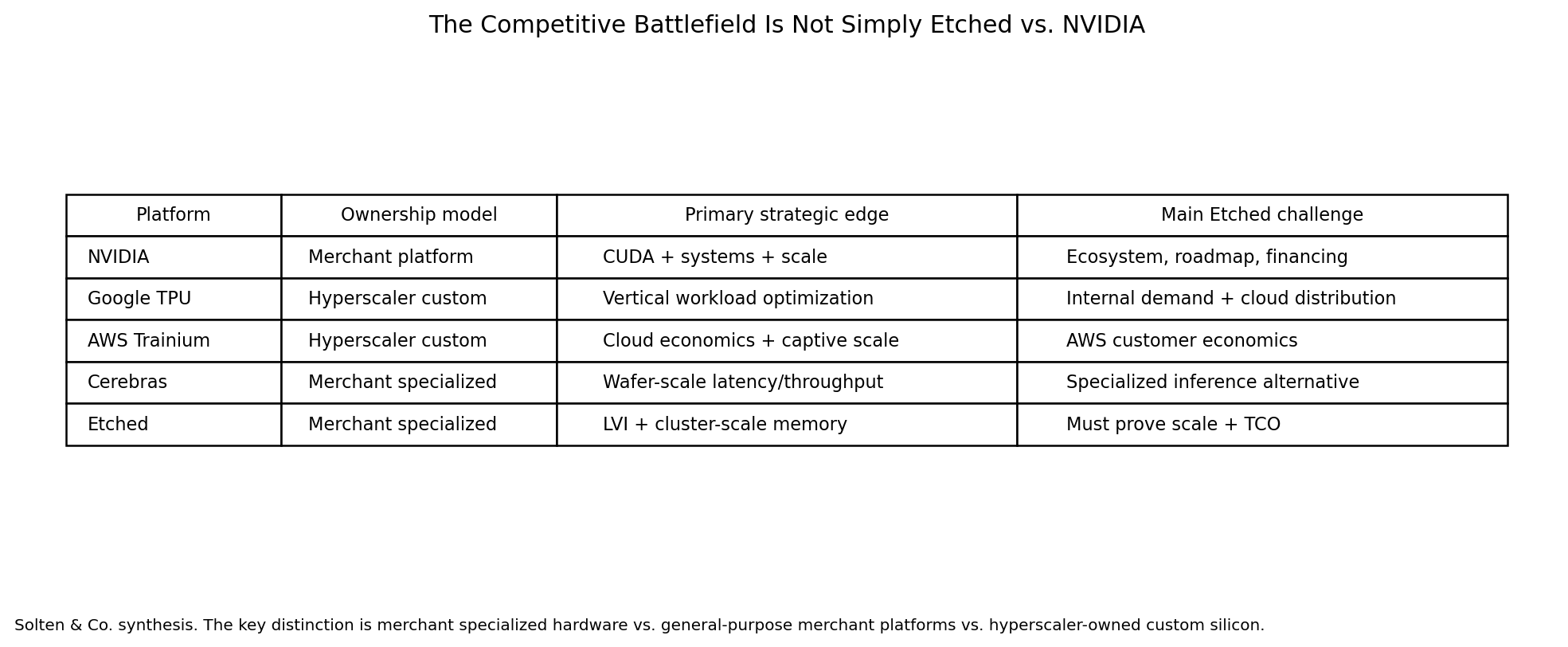
This framework separates merchant general-purpose platforms, hyperscaler-owned custom silicon and merchant specialized architectures. Etched’s strategic opening exists only if a meaningful customer segment wants hyperscaler-like specialization without owning a hyperscaler-scale internal silicon program.


The lazy framing is “Etched versus NVIDIA.” The real market is more complicated.


NVIDIA remains the dominant reference platform because it combines high-performance accelerators with CUDA, networking, systems, enterprise software, developer tooling, financing relationships and an enormous installed base. NVIDIA reported fiscal 2026 revenue of approximately $216 billion, with data-center growth driven by AI. Its gross margins remain above 70%, which demonstrates the economic value of platform control.


But NVIDIA is facing competition from several directions.


Hyperscaler custom silicon. Google TPUs, AWS Trainium, Microsoft Maia and Meta MTIA are increasingly important because the largest buyers have enough workload volume to justify architecture-specific optimization. Google and Broadcom have extended TPU collaboration through 2031, and Google is expanding external TPU distribution. AWS has made Trainium central to major OpenAI and Anthropic compute relationships.


Merchant accelerators. AMD remains the largest conventional GPU alternative. Cerebras uses wafer-scale processors and is explicitly targeting fast inference. Its newly announced CS-4 system illustrates how quickly the specialized-inference market is moving.


Specialized architectures. Groq demonstrated demand for low-latency inference and ultimately entered a major technology relationship with NVIDIA, a reminder that incumbent responses can include acquisition, licensing and ecosystem absorption rather than only price competition.


Other startups and new architectures. Tenstorrent, SambaNova, d-Matrix, Furiosa and others continue to pursue different combinations of programmability, memory architecture, inference efficiency and system design.


Etched is therefore competing on multiple dimensions:


  • tokens per dollar;
  • tokens per watt;
  • latency;
  • throughput;
  • programmability;
  • model compatibility;
  • memory capacity and bandwidth;
  • interconnect performance;
  • rack-level deployment complexity;
  • supply availability;
  • software maturity;
  • customer switching cost;
  • production scale.


The important market question is not whether one architecture wins universally. Independent accelerator research increasingly suggests that workload characteristics determine the optimal hardware. The likely market structure is heterogeneous.


Etched’s opportunity is to own a sufficiently valuable portion of that heterogeneity.


Market Structure: The Inference Economy Is Becoming Its Own Industry


The shift from training to inference is central to the Etched thesis.


Training creates frontier capability, but inference monetizes that capability. Every user query, coding-agent step, enterprise workflow and autonomous tool call creates recurring inference demand. As agentic systems perform longer reasoning chains and call other models or software repeatedly, the number of inference operations per unit of useful work can rise dramatically.


NVIDIA itself now describes inference as the dominant AI workload. The company’s fiscal 2026 annual materials state that inference has overtaken training as the primary workload and emphasize the changing economics of AI as models move into large-scale use.


This shift matters because inference rewards different optimization choices than training.


Training values flexibility, enormous distributed scale and rapid support for new model operations.


Inference can reward specialization when workloads are repeated at high volume. Once a model architecture is stable enough, purpose-built silicon can theoretically remove general-purpose overhead and optimize memory, scheduling and power around the real workload.


That creates a structural opening for companies like Etched.


But the same economics also motivate every hyperscaler to build custom silicon internally. Etched must therefore prove that a merchant specialized platform can compete not only with NVIDIA but with customers’ own chips.


Industry Impact: First-, Second- and Third-Order Effects


First-order effect: more credible competition in inference accelerators.


A working Etched system with a production customer increases pressure on NVIDIA and other accelerator vendors to compete on inference-specific economics rather than only headline training performance. It also gives AI labs and cloud providers another procurement option.


Second-order effect: greater bargaining power for large compute buyers.


Even if Etched never takes dominant market share, credible alternatives can influence NVIDIA pricing, supply terms and roadmap priorities. Large buyers gain leverage when they can move marginal inference workloads to specialized systems.


Second-order effect: more fragmentation in the software stack.


Every new accelerator creates integration cost. Model runtimes, compilers, kernels, observability, orchestration and deployment tooling must support heterogeneous systems. This creates opportunity for software layers that abstract hardware differences — but also raises switching costs for customers.


Second-order effect: more pressure on custom silicon economics.


If Etched can offer hyperscaler-like specialization without requiring a customer to design its own chip, it creates a new strategic option between buying NVIDIA and building an internal ASIC program.


Third-order effect: semiconductor value may shift from chips toward integrated inference systems.


Etched’s own evolution suggests that the economic unit is moving upward from the accelerator die to the rack or cluster. Memory, networking, cooling, power delivery, software and manufacturing become part of competitive differentiation.


Third-order effect: capital intensity spreads downstream.


If specialized inference becomes a major infrastructure category, large venture-funded companies may need hundreds of millions or billions of dollars to finance fabrication, inventory, systems and customer deployments before revenue scales. The distinction between venture capital and industrial project finance begins to blur.


Broader Economic Implications


Etched is one small company relative to the global semiconductor market, so macro claims should be restrained. But the financing contributes to several larger patterns.


AI is becoming more industrial. Capital is flowing not only into software but into fabs, packaging, memory, data centers, power, cooling, networking and purpose-built systems.


Inference efficiency has downstream economic significance. If specialized hardware materially lowers the cost per useful token, then applications that are currently uneconomic can become viable. That can affect pricing for AI software, enterprise automation and agentic workloads.


Hardware competition may also shift capital allocation. The stronger the evidence that inference supports multiple architectures, the more venture and growth capital may move toward specialized silicon, memory systems, networking and infrastructure software.


At the same time, the market risks overinvestment. High private valuations and massive compute commitments can create excess capacity if model monetization fails to scale at the pace assumed by infrastructure investors.


Risks to Etched


Technology risk. Performance claims may narrow under independent testing or production conditions. Different workloads may reduce the theoretical advantage of specialization.


Architecture risk. Although Etched’s 2026 system appears broader than the original transformer-only thesis, rapid changes in model architecture can still invalidate hardware assumptions.


Software risk. NVIDIA’s most durable moat is not only silicon. CUDA, libraries, tooling, developer familiarity and system integration create powerful switching costs.


Manufacturing risk. First-pass silicon is a major achievement but does not guarantee high-yield volume production across multiple generations.


Supply-chain risk. Etched depends on advanced foundry capacity, packaging, memory and other constrained semiconductor inputs.


Execution risk. Scaling from a few racks to gigawatt-scale deployments is an industrial challenge substantially harder than producing working A0 silicon.


Customer concentration risk. Only Jane Street is currently publicly identified. More than $1 billion in contracts could still be concentrated in a small number of counterparties.


Capital risk. Building inventory and production capacity may require further large financings before cash generation becomes self-sustaining.


Valuation risk. At $21 billion, execution disappointments can create severe private-market repricing even if the company remains technologically viable.


Incumbent-response risk. NVIDIA has the resources to respond through product acceleration, pricing, financing, software integration, partnerships or acquisition/licensing strategies.


Hyperscaler risk. The largest potential customers may prefer their own TPU, Trainium, Maia or MTIA systems rather than buying from a merchant startup.


Risks to Investors


The current round has unusually high expectations embedded in the entry price.


A successful product launch is not sufficient. Investors need Etched to sustain a major competitive position over multiple product generations.


Future dilution could materially raise required exit values. A capital-intensive company may need several more large rounds.


Private-market headline valuation does not disclose preference terms. Investors entering at different rounds may have very different downside protection.


The customer-investor overlap is both strength and risk. Strategic investors can accelerate adoption, but commercial relationships may make market demand appear stronger than it would under purely arm’s-length procurement.


Liquidity is uncertain. An eventual IPO must support a valuation far above current levels for venture-style returns, while strategic acquisition at extreme valuations becomes difficult because only a small set of buyers could finance it and antitrust considerations may constrain some obvious acquirers.


Risks to the Industry


Large financings can accelerate competitive innovation, but they can also distort market behavior.


Capital crowding. Well-funded hardware companies can bid aggressively for scarce semiconductor talent and supply capacity, raising costs for smaller entrants.


Supply concentration. More accelerator designs still depend on a small number of foundries, advanced packaging providers and memory suppliers.


Architecture fragmentation. Heterogeneous hardware can improve efficiency but increase software and operational complexity across the ecosystem.


Overcapacity. If inference demand disappoints, capital-intensive accelerator and data-center investments could create stranded or underutilized assets.


Synchronized assumptions. Many current AI infrastructure investments depend on the same premise: rapidly rising inference demand and sustained willingness to pay. Correlated error in that assumption would affect labs, clouds, chipmakers, power developers and infrastructure financiers simultaneously.


Scenario Analysis


Base Case


Etched successfully ramps production, converts a meaningful portion of its current contracts into recognized revenue and demonstrates superior inference economics on selected frontier workloads. It becomes a credible second-source or specialized accelerator supplier for several AI labs, clouds and high-performance enterprises. NVIDIA remains dominant overall, but Etched captures a defensible high-value niche and grows into a major infrastructure company.


Signals supporting this case: several named production customers; independent benchmark validation; repeat orders; evidence of improving gross margins; second-generation silicon delivered on schedule; expansion beyond Jane Street without sacrificing performance.


Upside Case


Inference becomes substantially larger than training in total compute spend, and workloads increasingly reward specialization. Etched’s architecture demonstrates a durable cost and power advantage while its system integration reduces migration friction. Hyperscalers use Etched as a merchant alternative to internal ASIC programs, AI labs adopt the systems at multi-gigawatt scale, and the company becomes an independent platform with economics closer to a leading accelerator vendor than a niche chip supplier.


In this case, a valuation above $100 billion becomes plausible.


Signals supporting this case: multi-gigawatt customer commitments, very strong gross margins, broad model compatibility, major cloud distribution, sustained performance-per-watt advantage over two NVIDIA generations, rapid third-generation product execution.


Downside Case


Etched’s initial systems work but deliver a narrower advantage than expected once real-world utilization, software costs and new NVIDIA platforms are considered. The $1 billion-plus contracts convert slowly, customers retain Etched as experimental capacity rather than core production infrastructure, and hyperscalers prioritize internal silicon. High production spending forces further financing, compressing returns for current investors.


Signals supporting this case: delayed deliveries, limited independent benchmarking, cancellations or contract slippage, continued customer anonymity, heavy pricing discounts, rising inventory, repeated financing before meaningful revenue, slower roadmap execution.


Solten & Co. Thesis


The Etched financing is evidence that the AI accelerator market is moving from a single dominant architecture toward a portfolio of workload-specific compute systems.


The important economic variable is not “Can Etched beat NVIDIA?” in the abstract. It is whether the cost of inference becomes large and repetitive enough that customers are willing to accept hardware and software fragmentation in exchange for materially better tokens per dollar, tokens per watt and latency on specific high-value workloads.


If that threshold has been crossed, Etched does not need to replace NVIDIA. It needs to become economically indispensable for a sufficiently large subset of inference.


The round suggests sophisticated investors believe that subset may be very large.


Counter-Thesis


The strongest counter-thesis is that the market is overestimating the value of specialized silicon while underestimating the value of general-purpose platform integration.


NVIDIA can amortize R&D across a vastly larger installed base, improve hardware every generation, bundle networking and systems, subsidize adoption through financing and maintain developer lock-in through CUDA. Hyperscalers can optimize internally for their own workloads without paying a merchant supplier margin.


Etched therefore occupies a difficult middle position: more specialized and less ecosystem-rich than NVIDIA, but less vertically integrated with end-customer demand than Google or AWS custom silicon.


The company must show that its system-level efficiency advantage is large enough to overcome that structural disadvantage.


Falsification Criteria


The Solten & Co. thesis would weaken materially if several of the following occur:


  • independent production benchmarks show only modest total-cost advantage over NVIDIA or hyperscaler alternatives;
  • customer contracts fail to convert into deployments and recognized revenue;
  • the majority of demand remains concentrated in Jane Street or one or two counterparties;
  • new model architectures materially reduce the efficiency of Etched’s hardware approach;
  • NVIDIA’s next two platform generations close most of the tokens-per-watt or latency gap;
  • Etched requires repeated large financings without corresponding commercial scale;
  • software migration becomes a persistent barrier to production adoption;
  • hyperscalers refuse to adopt merchant specialized inference hardware because internal chips are economically superior.


Key Unknowns


The public investment case remains constrained by missing information. The highest-value unanswered questions are:


  1. What is Etched’s recognized revenue today?
  2. How much of the $1 billion-plus contract value is legally binding and non-cancellable?
  3. What is customer concentration?
  4. What is the expected delivery schedule for those contracts?
  5. What are current and expected gross margins per rack?
  6. What is actual production yield?
  7. What is the all-in system cost per token under realistic production workloads?
  8. How does Etched compare with NVIDIA Blackwell and Vera Rubin under identical model, precision, latency and batch conditions?
  9. What percentage of workloads can run without material software modification?
  10. What foundry, HBM and packaging capacity is contractually secured?
  11. How much additional capital will be required before positive free cash flow?
  12. What are the preference and governance terms in the latest round?
  13. How much ownership did Jane Street obtain?
  14. Which frontier AI companies and cloud providers are under contract?
  15. What proportion of current contracts relate to first-generation versus future-generation systems?


What to Watch Next


The next six to eighteen months should provide far more information than the financing announcement itself.


The critical signals are:


  • additional named customers;
  • independent benchmark publication;
  • production shipment volume;
  • contract conversion to revenue;
  • second and third hardware generation milestones;
  • hyperscaler adoption;
  • broader software ecosystem availability;
  • pricing disclosure or customer total-cost evidence;
  • manufacturing scale and yield;
  • additional fundraising;
  • changes in NVIDIA inference pricing and roadmap;
  • competitive launches from Cerebras, AMD, AWS, Google and other accelerator providers;
  • any evidence that Etched is becoming a standard merchant alternative rather than a specialist system for a narrow set of customers.


Research Exhibits


Exhibit 1 — Etched Valuation Trajectory
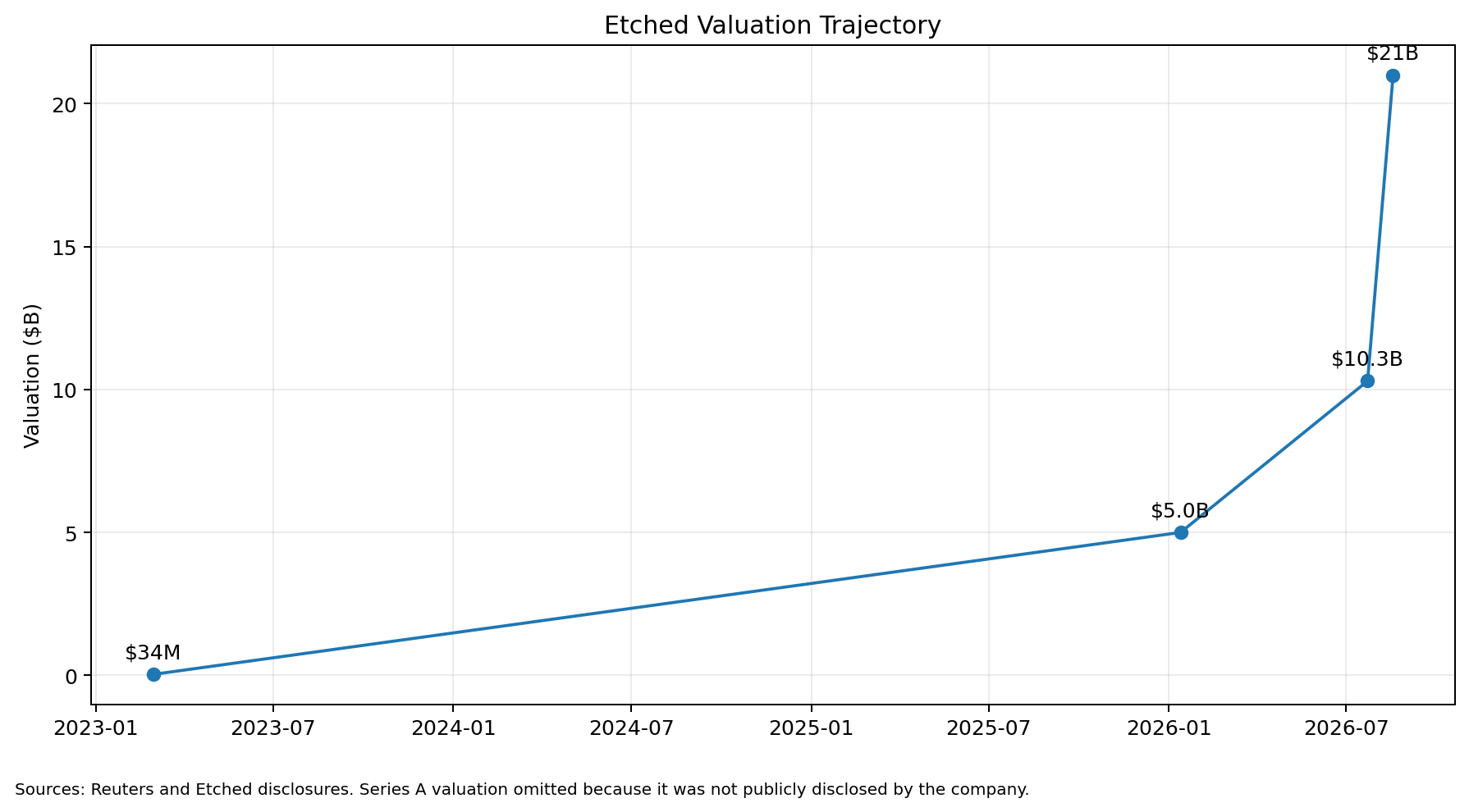
The valuation trajectory illustrates how rapidly market expectations have changed. The Series A valuation is intentionally omitted because Etched did not publicly disclose it at the time.


Exhibit 2 — Known Financing Rounds
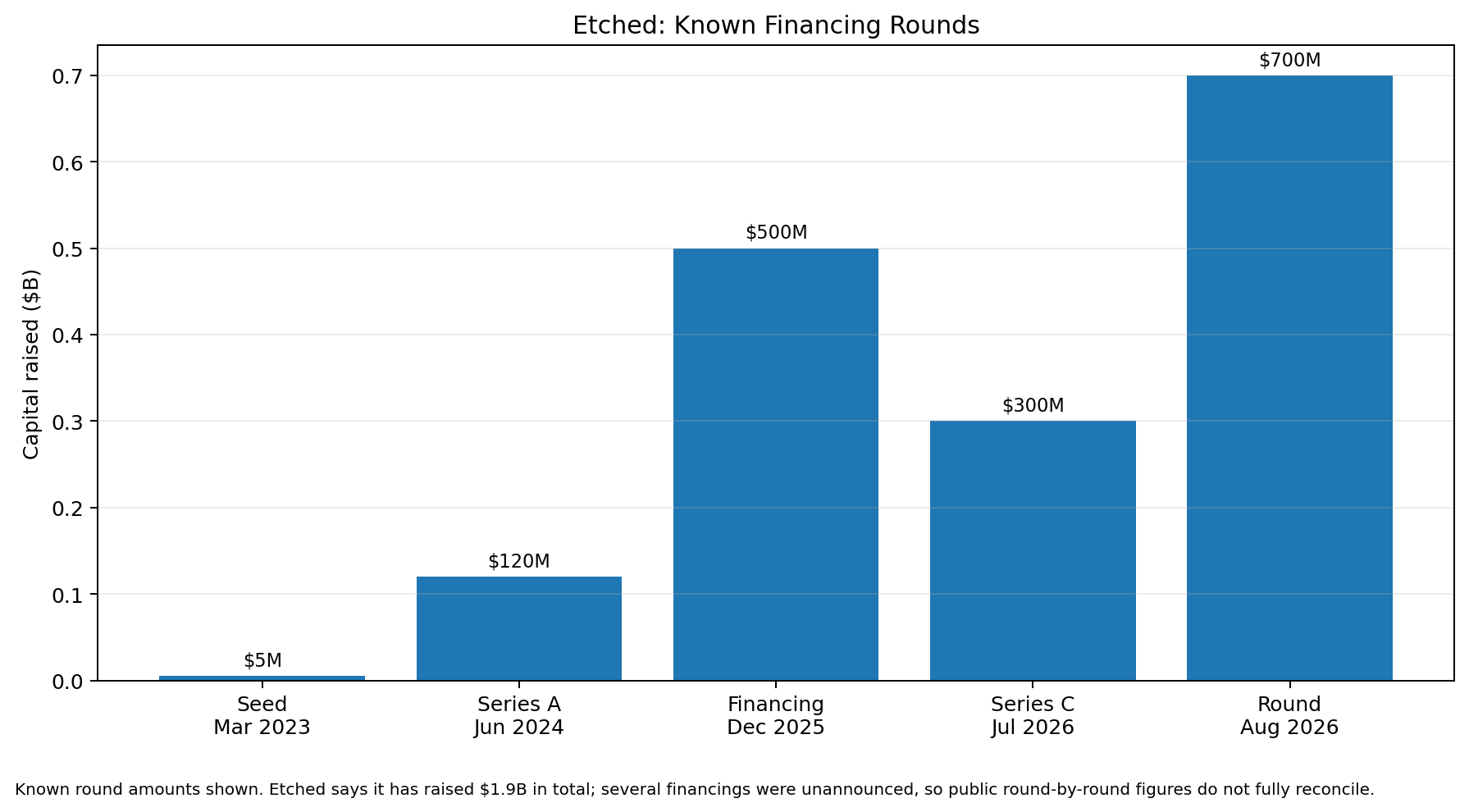
Public financing records do not fully reconcile to Etched’s stated $1.9 billion total because several rounds were unannounced and historical totals were rounded. The correct approach is to preserve that uncertainty rather than manufacture precision.


Exhibit 3 — What a $21 Billion Entry Valuation Implies
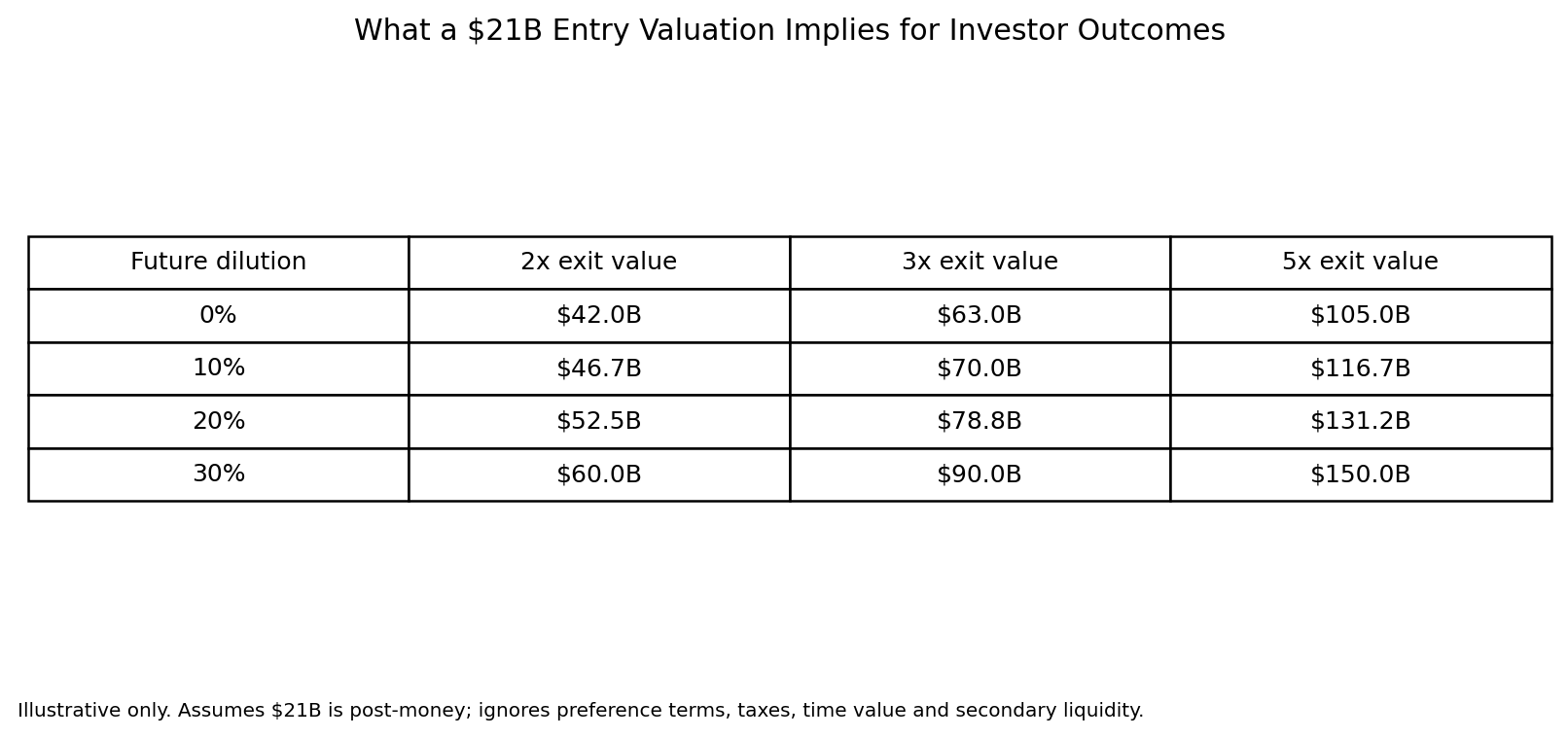
This is an illustrative return-hurdle model, not a valuation forecast. It demonstrates how future dilution raises the exit value required for current investors to achieve venture-style returns.


Sources & Evidence


Primary / company sources


Etched — Frontier Inference Clusters, June 30, 2026

https://www.etched.com/progress/frontier-inference-clusters


Etched — company website and leadership materials

https://www.etched.com/


Etched — $300M financing at $10.3B valuation, July 23, 2026

https://www.globenewswire.com/news-release/2026/07/23/3332366/0/en/Etched-raises-300M-at-a-10-3B-Valuation-to-Scale-Production-of-Frontier-Scale-Inference-Hardware.html


Etched — $700M financing at $21B valuation / first Jane Street delivery, August 18, 2026, company release syndicated by AIwire

https://www.hpcwire.com/aiwire/2026/08/18/etched-raises-700m-at-21b-valuation-and-completes-1st-customer-delivery-to-jane-street/


CoreWeave — Jane Street $6B cloud agreement and $1B equity investment, April 15, 2026

https://www.coreweave.com/news/jane-street-signs-6-billion-ai-cloud-agreement-with-coreweave


NVIDIA — FY2026 annual results

https://investor.nvidia.com/news/press-release-details/2026/NVIDIA-Announces-Financial-Results-for-Fourth-Quarter-and-Fiscal-2026/


NVIDIA — FY2026 Form 10-K

https://www.sec.gov/Archives/edgar/data/1045810/000104581026000021/nvda-20260125.htm


Google Cloud — Anthropic expands TPU usage, April 6, 2026

https://www.googlecloudpresscorner.com/2026-04-06-Anthropic-Expands-Use-of-Google-Cloud-and-TPUs


High-quality reporting / research


Reuters — AI chip startup Etched doubles valuation to $21 billion in under a month, August 18, 2026

https://www.reuters.com/technology/ai-chip-startup-etched-valued-21-billion-latest-funding-round-2026-08-18/


Reuters — Etched raises $120 million to develop specialized chip, June 25, 2024

https://www.reuters.com/technology/artificial-intelligence/ai-startup-etched-raises-120-million-develop-specialized-chip-2024-06-25/


Reuters — Jane Street signs $6B AI cloud deal with CoreWeave, April 15, 2026

https://www.reuters.com/legal/transactional/jane-street-signs-6-billion-ai-cloud-deal-with-coreweave-boosts-stake-2026-04-15/


Reuters — Cerebras launches new inference server system, August 19, 2026

https://www.reuters.com/technology/cerebras-launches-new-server-chip-system-designed-speed-ai-chatbots-2026-08-19/


Reuters — Broadcom signs long-term Google custom AI chip agreement, April 6, 2026

https://www.reuters.com/business/broadcom-signs-long-term-deal-develop-googles-custom-ai-chips-2026-04-06/


TechCrunch — Etched Series C at $10.3B valuation, July 23, 2026

https://techcrunch.com/2026/07/23/ai-chip-startup-etched-defies-skeptics-hits-10-3b-valuation-from-big-name-investors/


TechCrunch — Etched Series A / transformer-only strategy, June 25, 2024

https://techcrunch.com/2024/06/25/etched-is-building-an-ai-chip-that-only-runs-transformer-models/


Primary Venture Partners — Etched Series A thesis / company history

https://www.primary.vc/articles/etcheds-series-a-to-revolutionize-ai-hardware


Academic research — The xPU-athalon: Quantifying the Competition of AI Acceleration, 2026

https://arxiv.org/abs/2604.10852


Methodological Note


This report distinguishes disclosed facts, reported terms, estimates and Solten & Co. interpretation.


DISCLOSED FACT — directly supported by a company, regulatory or authoritative primary source.


REPORTED TERM — reported by a credible secondary source but not independently disclosed in full by the relevant company or counterparty.


ESTIMATE — an analytical calculation based on incomplete public data. Assumptions are stated where material.


SOLTEN & CO. INTERPRETATION — our synthesis or inference from the evidence.


The report does not treat contract value as revenue, valuation as enterprise value, or headline round size as sufficient evidence of ownership. Private-company financial statements, cap-table terms, contract schedules and detailed customer economics are not publicly available. Valuation return scenarios are illustrative and do not represent an investment recommendation.


About Solten & Co.


Solten & Co. is an independent research and analysis firm focused on the AI economy, with deeper research emphasis on AI infrastructure, Physical AI, robotics and autonomous systems. We study the technologies, companies, markets, transactions and capital structures shaping the next phase of AI.


Need an independent perspective?


Solten & Co. provides independent research and analytical support for investors and decision-makers evaluating companies, markets and investment opportunities across the AI economy.


Discuss a research question · Discuss an investment opportunity · Request independent analysis

soltenco.com

The Return of Marginal Cost

How to underwrite AI-native software when usage, quality and economics move
together.

SOLTEN & CO. RESEARCH  |  PUBLIC RESEARCH BRIEF  |  25 AUGUST 2026  |  RA-0009

KEY THESIS  The correct unit of analysis is the accepted workflow—not the seat, token or API call. Falling model prices help, but durable economics appear only when value captured per accepted workflow improves faster than total workflow intensity, rework and non-model variable costs.

Research snapshot

Field Detail
Research question How should investors underwrite AI-native application software when marginal cost, output quality and customer value all vary with usage?
Evidence cut-off 25 August 2026
Audience Family offices, venture/growth investors, lean investment teams and strategy leaders
Reading time 12–15 minutes
Scope Application-layer economics; not a company rating, financing analysis or valuation opinion

Executive summary

Software investors learned to value businesses whose cost of serving an additional user approached zero. AI reintroduces a meaningful variable-cost stack: model inference, tool calls, retrieval, orchestration, evaluation, human review and support. The familiar SaaS shorthand—annual recurring revenue, seats and gross margin—still matters, but it can hide whether greater adoption makes the product economically stronger or merely more expensive to operate.

The market’s first instinct has been to treat inference prices as the answer. That is too simple. Stanford’s AI Index found that the cost of querying a model with GPT-3.5-level benchmark performance fell from about $20 per million tokens in November 2022 to $0.07 by October 2024, a decline of more than 280 times.[1] Yet an agent that makes five times as many model calls, uses longer contexts or triggers more tools can consume the entire saving. An 80% decline in unit price combined with a fivefold increase in workload leaves total model cost unchanged.

Quality makes the equation harder. In a field study of 5,179 customer-support agents, generative AI raised issues resolved per hour by 14% on average and by 34% for novice and lower-skilled workers.[5] In a separate experiment involving 758 consultants, people working inside the technology’s capability frontier completed more tasks, worked faster and produced higher-quality output; on a task outside that frontier, AI users were 19 percentage points less likely to reach the correct answer.[6] The economic value of AI therefore depends on the workflow, the user and the cost of detecting failure—not merely on access to a capable model.

Our conclusion is that investors need a new primary unit: contribution margin per accepted workflow. “Accepted” means the customer or a defined control process accepts the output without material rework, reversal or undisclosed human completion. Revenue should be measured against every variable cost required to produce that accepted result, including failed attempts and escalations. This approach makes unlike pricing models comparable and exposes companies whose apparent automation is funded by invisible labour or unchecked risk.

What changed

  • Intelligence became a metered input. API calls, context length, output length, tools and agent loops can all scale with use.[8], [13], [14]
  • Quality became part of unit economics. Evaluation, monitoring and human review are operating costs, especially where errors are consequential.[7], [20], [21]
  • Pricing moved beyond seats. Vendors now combine subscriptions, credits, usage and outcomes, shifting cost and quality risk between buyer and seller.[9], [10], [12], [23]
  • Model choice became an optimisation layer. Routing, caching and asynchronous processing can reduce cost, but add engineering and governance complexity.[15]–[18], [24], [25]
  • Gross-margin dispersion widened. Selected high-growth private AI companies report economics far below mature public SaaS benchmarks.[2]–[4]

Exhibit 1. Benchmark orientation: the margin gap is real, but the samples are not comparable

Sources: Salesforce FY2025 Form 10-K; ServiceNow FY2025 Form 10-K; Bessemer State of AI 2025. Salesforce figure calculated as 1 − $6.198bn / $35.679bn. Bessemer figures are selected private-company averages, not audited market benchmarks.[2]–[4]

The first mistake: treating token deflation as margin expansion

Model prices have fallen quickly, and providers offer cheaper cached input, asynchronous batches and smaller models.[13]–[15], [24], [25] Those mechanisms can improve cost. They do not determine total workflow economics. A workflow may become more ambitious as models improve: longer contexts, more retrieval, parallel agents, repeated reasoning, tool calls and verification. In agentic systems, model calls can branch or loop. Both Anthropic and the major cloud platforms advise using the simplest architecture that meets the task because added autonomy trades cost and latency for performance.[16]–[18], [26], [27]

Exhibit 2. Unit-cost deflation versus workload expansion

Source: Solten & Co. illustrative model. Each cell is (1 − unit-price decline) × workload multiplier. It excludes non-model costs and is not a forecast.

The implication is practical. Management should report both the price paid per unit of compute and the number of units required per accepted result. If model cost per token falls 50% while tokens per accepted workflow triple, model cost per accepted workflow rises 50%. A company that highlights the first number and omits the second is not showing its economics.

The second mistake: measuring automation without acceptance

An automation rate can overstate value if it counts attempts rather than accepted results. A workflow may appear automated while customers reopen cases, employees rewrite the output or a hidden operations team completes exceptions. NIST treats confabulation and downstream reliance as material risks; Google’s deployment guidance describes evaluation as a core operating process and notes that manual evaluation can become a bottleneck.[7], [20]

The quality-adjusted automation rate should therefore be calculated as accepted outcomes divided by attempted workflows. The definition of acceptance must be tied to the customer’s job: a support resolution that is not reopened, code that passes tests and is merged, a claim that survives audit, or a document approved without material rewrite. Intercom’s published approach separates AI involvement from resolution and charges for defined outcomes rather than unsuccessful attempts, illustrating the direction of travel even though the exact commercial definition remains vendor-specific.[10], [11]

Exhibit 3. A four-layer underwriting hierarchy

Source: Solten & Co. framework.

The six metrics that matter

Metric Definition Why investors need it
Contribution margin / accepted workflow Revenue less all variable model, tool, infrastructure, review, support and risk costs, divided by accepted workflows Reveals whether usage creates economic value
Quality-adjusted automation Accepted outcomes ÷ attempted workflows Prevents failed attempts and hidden labour from appearing automated
Workload elasticity Change in model calls, tokens and tools per workflow relative to unit-price change Tests whether cost deflation survives product ambition
Cost-to-serve distribution P50, P90 and P99 variable cost by customer/cohort/workflow Exposes heavy users and tail-risk contracts
Retention after novelty Cohort retention and expansion after initial experimentation Separates durable workflow ownership from curiosity
Provider dependency Share of cost and quality tied to one model/provider; time and quality loss to switch Measures bargaining power and resilience

Pricing is a risk-allocation decision

Seat pricing gives customers budget certainty but leaves the vendor exposed when usage varies widely. Pure usage pricing transfers much of that risk to the buyer, though it can weaken adoption. Outcome pricing aligns with value only where the result is observable and reversals are measurable. Hybrid pricing—base subscription plus included credits or usage—often provides the best bridge because it combines predictability with a limit on unbounded cost. GitHub Copilot’s plans, for example, combine subscription tiers with included AI credits; Stripe documents subscription, usage, outcome and hybrid patterns for AI companies.[8], [9], [12], [23]

What investors should ask

  • What exactly is an accepted outcome, and how often is it reversed, reopened or materially edited?
  • Show revenue, model cost, tool cost, human review and support per accepted workflow—monthly and by cohort.
  • How do P90 and P99 customers compare with the median? Which contracts are contribution-negative?
  • If model prices fall 80%, how much more inference does the product consume? If prices rise or discounts disappear, what reprices?
  • How much labour sits outside cost of revenue? What happens to gross margin if evaluation and review are classified consistently?
  • Does retention persist after experimentation? Is expansion caused by greater customer value or merely by more metered usage?
  • Can the company route across models without losing quality? What proprietary context, distribution or integration survives model commoditisation?

Counter-thesis

The strongest counterargument is that this framework may overstate the break from SaaS. Inference prices could fall faster than workloads expand; products could standardise; customers could continue to prefer simple subscriptions; and many AI features may become low-cost functionality inside conventional software. If those conditions hold, mature AI applications could converge toward classic software margins. The framework would then remain useful mainly during the transition.

That counter-thesis is falsifiable. We would reduce the weight placed on accepted-workflow economics if several conditions persist across cohorts: model and tool cost per workflow falls faster than usage expands; human escalation approaches zero without worsening outcomes; P90 cost-to-serve converges toward the median; retention remains strong after novelty; and vendors achieve public-software gross margins without restricting useful consumption. Until then, the burden of proof should remain on the unit economics.

What to watch

  • Contribution margin per accepted workflow, especially for mature cohorts.
  • Tokens, model calls and paid tool calls per workflow as capability expands.
  • Reopen, reversal, escalation and material-edit rates—not only vendor-reported automation.
  • P90/P99 cost-to-serve and the share of negative-contribution customers.
  • Pricing migration: unlimited seats toward credits, usage caps, outcomes or hybrids.
  • Multi-model routing, caching and batch adoption, with quality held constant.
  • Retention and expansion after pilots convert into production workflows.
  • Gross-margin reconciliation: whether human operations, evaluation and support sit in cost of revenue.

Conclusion

AI-native software can become an exceptional business. It can also look like software while carrying the economics of a service, an infrastructure layer or an insurance contract. The distinction is not visible in ARR alone. It appears at the level of the accepted workflow: what the customer values, what it costs to deliver reliably, how often automation truly succeeds and who bears the tail risk. The companies that learn to improve that equation—through product design, routing, proprietary context, distribution and disciplined pricing—will turn cheaper intelligence into durable margin. The rest may discover that marginal cost did not disappear. It merely moved.

Sources and evidence

Evidence cut-off: 25 August 2026. Vendor pricing and implementation pages are used to document commercial structures and technical mechanisms, not to validate vendor performance. Private-company benchmarks are attributed and treated as directional. Adjacent citations are separated for legibility.

  1. Stanford HAI, AI Index 2025: inference cost decline for GPT-3.5-level performance. Source
  2. Bessemer Venture Partners, The State of AI 2025: private-company growth and gross-margin archetypes. Source
  3. Salesforce FY2025 Form 10-K: subscription and support revenue and cost. Source
  4. ServiceNow FY2025 Form 10-K: subscription gross-profit percentage. Source
  5. NBER, Generative AI at Work: field study of 5,179 customer-support agents. Source
  6. Dell’Acqua et al., Organization Science, Navigating the Jagged Technological Frontier. Source
  7. NIST AI 600-1, Artificial Intelligence Risk Management Framework: Generative AI Profile. Source
  8. Stripe, AI companies and usage-based billing. Source
  9. Stripe, AI pricing models. Source
  10. Intercom, Fin AI Agent outcomes and outcome pricing. Source
  11. Intercom, Fin AI Agent automation rate. Source
  12. GitHub, Copilot plans and included AI credits. Source
  13. OpenAI API pricing. Source
  14. Anthropic API pricing and prompt-caching structure. Source
  15. Google Gemini API, context caching. Source
  16. Anthropic, Building effective agents. Source
  17. AWS Bedrock, Intelligent Prompt Routing. Source
  18. AWS, Generative AI Lens — Well-Architected Framework. Source
  19. Google Cloud Architecture Framework, AI and ML cost optimisation. Source
  20. Google Cloud, deploy and operate generative AI applications. Source
  21. OpenAI API reference, Evals. Source
  22. AWS Bedrock, cost allocation by request. Source
  23. Stripe, token-based billing implementation patterns. Source
  24. OpenAI, Prompt Caching. Source
  25. OpenAI API reference, Batch API. Source
  26. Google Cloud, choosing a design pattern for an agentic AI system. Source
  27. AWS Prescriptive Guidance, cost optimisation for agentic AI. Source

Research disclosure

This report is independent research for informational purposes. It is not investment, legal, tax or accounting advice and does not recommend a security or transaction. The analysis relies on public information available by the evidence cut-off. Illustrative scenarios are analytical tools, not forecasts. Private-company operating data are incomplete; readers should obtain company-level cohort, billing, inference and support records before making an investment decision.